

NEW YORK CITY - October 28, 1976
The Sports Time Traveler is concluding a virtual trip to 1976 to experience The New York Marathon, which took place on Sunday, October 24, 1976.
Here in 1976, this past Sunday was horrid for hometown fans of New York sports teams.
Yankees followers were still reeling from being swept in the World Series by a combined score of 22 - 8 across the 4 games, the last two of which played in near freezing weather in the Bronx.
Giants’ football rooters, already suffering through the worst start in franchise history (0 - 6), witnessed a 27 - 0 loss inside brand new Giants Stadium. The New York Times’ Michael Katz quipped, “There were 6,657 no-shows today for the Giants’ second game in their new stadium, and that’s not counting the Giants’ offense.” Now halfway through the season, the Giants have still yet to win a single game.
Jets fanatics were experiencing something even more unfathomable. In Shea Stadium, they watched Joe Namath get “knocked dizzy,” according to the Daily News, as the Jets were blanked by Baltimore 20 - 0, dropping their record to 1 - 6. But more ignominiously, the Jets have just 50 points for the entire season (that’s just 7 points per game), while allowing 192, for the worst point spread in the NFL by a wide margin, far more futile than the expansion, and winless, Tampa Bay Buccaneers.
Yet on this day, and from this abyss in the Big Apple, emerged a sporting enigma embraced by half a million residents grasping for something to cheer. An ancient solitary sport was successfully transformed into a spectacle celebrating all 5 boroughs in the city - The New York Marathon.
Background on The 1976 New York Marathon
The New York Marathon was first run in 1970 with just 55 finishers. From 1970 to 1975, the race was a small affair taking place entirely within the confines of Central Park. Even last year, in 1975, there were only 339 finishers.
This year, in 1976, the race was vastly expanded. For the first time, the course started at the base of the Verrazzano Bridge in Staten Island and traversed all 5 of New York City’s boroughs, finishing in Manhattan in Central Park. And for the 1st time, a world class field was assembled with travel expenses being paid to top competitors.
In addition, a large number of entries were accepted for the first time, with 2,075 race numbers given out, including 104 women.
The Field
By one measure the field was the greatest in history ever assembled. Never before had 5 of the top 12 male marathon runners in history, based on personal best times, ever been in the same race. Even the recent Montreal Olympic Marathon only had 3 of the top 12 runners based on historical best times.
These top 5 competitors in the 1976 New York Marathon were:
FRANK SHORTER (USA) - The 1972 Olympic gold medalist and 1976 Olympic silver medalist. Shorter has been the face of American marathon running for the past several years. His 1972 gold medal run sparked the running boom in the U.S. He is the favorite to win and avenge his loss in the Montreal Olympics, 2 months ago, where he also was the favorite to repeat as gold medalist. The New York Times last Sunday morning wrote, “Much of the spectator focus will be on Shorter.”
IAN THOMPSON (Great Britain) - Winner of the 1974 Commonwealth Games marathon gold medal. His 2:09:12 is the 2nd fastest time in history.
RON HILL (Great Britain) - Hill was regarded as the best marathon runner in the world prior to the 1972 Olympics and was the favorite to win the gold medal that had eluded him in the 1964 and 1968 Olympics. He had famously won the Boston Marathon in 1970 in record time.
BILL RODGERS (USA) - Rodgers burst onto the world class marathon running scene in 1975 when he won the Boston Marathon, breaking Ron Hill’s course record, and also setting a new American record for the marathon. But Rodgers faltered in the Montreal Olympic marathon this past July finishing in 40th place.
AKIO USAMI (Japan) - Winner of the esteemed Fukuoka Marathon in 1970 in a time that was the 3rd fastest ever run up to that time.
SPECIAL NOTE From The Sports Time Traveler
Sorry to interrupt, but I have to inform you that in 2024, the former world record time by Australia’s Derek Clayton of 2:08:34 set in 1969 was invalidated as the course was found to be 430 meters short. Thus, Ian Thompson’s 2:09:12 was the rightful world record at the time of the 1976 New York Marathon.
Now back again to 1976.
The Start
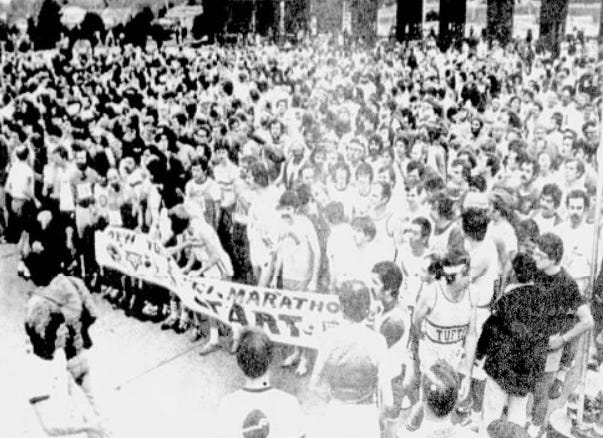
It was 49 degrees at the base of the Verrazano Bridge when the gun went off at 10:40am on Sunday. Temperatures were only expected to just barely top 50 in the afternoon, almost perfect for marathon running.
Here’s a picture of the scene at the start:
The Flying Finn
A Finnish runner, Pekka Paivarinta, took the early lead, perhaps trying to emulate the great Flying Finn from 50 years earlier, Paavo Nurmi. Paivarinta came through 5 miles at a 4:45 mile pace. That’s a 2:04 marathon pace, nearly 5 minutes faster than the world record at this time. By mile 8, Paivarinta had a 42 second lead. But his pace wasn’t sustainable.
And Frank Shorter knew it, so he and 10 other runners, including Bill Rodgers, stayed back in a pack well behind the foolish Finn. In Brooklyn, Shorter’s pack was about 4 blocks behind Paivarinta. Shorter discussed Paivarinta’s startling early pace with Neil Amdur of The New York Times after the race, “He did that in Japan. He died then and he died today.” Shorter was using the running lingo, common here in the 1970s, in which dying in a race meant that a runner tired badly and faltered.
The Staten Island Advance’s Jay Price noted that Paivarinta was still in the lead at 10 miles at an average pace of 4:47 per mile, still over 3 minutes under world record pace. But the top runners weren’t ready to panic. Bill Rodgers told Price, “We knew there was no way he could last.”
It was finally Bill Rodgers and Chris Stewart who caught Paivarinta just prior to mile 12.
At 14 miles, Rodgers edged ahead of Stewart taking sole possession of 1st place.
A Bridge Too Far
At 16 miles, Rodgers pulled away from Stewart as they went up the steep Queensboro Bridge into Manhattan. Rodgers told Amdur of the Times, “The iron gratings probably made it difficult, I sensed he was laboring there.”
After they got off the bridge the race scene looked dramatically different. Joe Concannon of the Boston Globe wrote about Rodgers, “He turned up East River Drive, looked back and saw no one.”
Rodgers was enjoying the cool weather and the lack of rain except for a little drizzle. He told Price, “Conditions were good. This was ideal for me.”
Along the way the marathoners were also enjoying the cheers of the estimated 500,000 New Yorkers who came out to watch the parade of runners. The race was not televised, so if you wanted to experience it you had to get out and see it.
Marathon Man
Some spectators may have been intrigued to see the runners because of all the hoopla surrounding the new blockbuster movie, MARATHON MAN, starring Dustin Hoffman, which opened less than 3 weeks ago. The movie takes place right here in New York City. Despite its name, the film does not revolve around running. It’s a psychological action thriller in which Dustin Hoffman’s character happens to be a distance runner.
Back to the race, Bill Rodgers continued to pull away from the field with less than 10 miles remaining. He told Steve Marcus of Newsday, “My strategy was to have an even pace.” Rodgers had been gunning for the New York Marathon since his failure in Montreal. He told Marcus that he had been training “between 140 and 160 miles per week.” And he indicated he would train even more if he had time. He presently works as a high school teacher in Massachusetts.
The Exchanging of the Guard
Fellow Massachusetts resident, Joe Concannon, was the only reporter to capture an amusing exchange that happened in the latter half of the race. At miles 19 and 20, the runners crossed the Willis Avenue Bridge from Manhattan into the Bronx, ran a loop in the Bronx and then returned over the bridge back into Manhattan.
Rodgers was so far in front of Frank Shorter that he was crossing back over the bridge into Manhattan while Shorter was running the bridge into the Bronx. As Rodgers passed Shorter, the man who was regarded as America’s best marathon runner, Frank Shorter, said to Bill Rodgers, “Nice going Billy.” Rodgers returned the compliment with a smile and a wave.
It was akin to an exchanging of the guard in American marathon running.
Frank Shorter had beaten Bill Rodgers the first 5 times they ran head-to-head. But now Bill Rodgers had an insurmountable lead and he went on to win the New York Marathon. In doing so Rodgers obliterated the former New York record by 9 minutes in a time of 2:10:10.
Bill Rodgers’ time was the 8th fastest ever run in a marathon.
Rodgers finished over 3 minutes ahead of Frank Shorter’s 2nd place time of 2:13:12. Shorter caught Chris Stewart who finished just 9 seconds back in 3rd.
A Devastating Performance
Concannon described Bill Rodgers’ race in the Boston Globe as, “A devastating performance against one of the strongest marathon fields ever brought together.”
Rodgers was humbled by the victory. He told Concannon, “People expect Frank Shorter to beat me. This never happened to me before.”
Frank Shorter offered this summary of the marathon to Concannon in the Boston Globe, “About halfway into the race, Bill just ran away from everyone. I ran hard. I didn’t have a particularly good day. He did.”
Rodgers credited his training for the victory telling Concannon, “I trained very hard after Montreal. Harder than I ever trained… I was psyched up.”
The Other Top Finishers
After the top 3, there was another 3 minute gap to 4th place finisher Richard Hughson of Toronto in 2:16:10.
The Finn, Pekka Paivarinta, didn’t die as badly as Shorter made it sound. He captured 5th place in 2:16:17.
The 1973 and 1975 champion, local runner Tom Fleming, ran his best ever New York Marathon time finishing 6th in 2:16:52.
Ron Hill and Akio Usami finished 9th and 10th. And Ian Thompson faded to 22nd place.
The First Woman and a New Record
The first woman finisher was 41-year-old Miki Gorman of the San Fernando Track Club outside Los Angeles. She was 71st overall in the race in a time of 2:39:11. She won the women’s division by 14 minutes!
Not only was Miki Gorman the first woman, but at 41-years-old she broke her own world record for the best marathon time ever for a woman over the age of 40.
FINAL NOTES From The Sports Time Traveler
The Sports Time Traveler has been a lifelong distance runner competing from junior high school at age 14 to the National Senior Games at age 54.
I can firmly trace my love of distance running to the day when Frank Shorter won the marathon at the 1972 Olympics. I was just 9-years-old, but I remember being glued to the TV watching the race unfold, and seeing the imposter who ran a “victory lap” on the track before Shorter entered the stadium by himself, far ahead of the field.
Four years later, my father and grandfather took me on the trip of a lifetime to Montreal in 1976 to see the track & field events at the Olympics. I was ecstatic as I got to see New Zealand’s Johnny Walker win the 1,500, and Finland’s Lasse Viren win the 5,000 and 10,000, and then attempt to run the marathon.
But my biggest memory of the Montreal Olympics was the bitter disappointment when America’s Frank Shorter did not enter the stadium in the lead. Oh, how I had wished to revel in Shorter repeating as the gold medalist, and being there in person to witness running history.
The TV audience knew that a relative unknown, Waldemar Cierpinski of East Germany had taken the lead and was headed for victory late in the race. But inside the stadium they had stopped giving us updates after about the 10 mile mark. And of course pre-internet and pre-cell phones, no one in the stadium knew how the race was unfolding.
There is now considerable evidence that Cierpinski used performance enhancing drugs and that Shorter was cheated out of that 2nd gold medal.
After the 1976 New York Marathon, I became a Bill Rodgers fan as well. Rodgers seemed like such a likable guy. And 25 years later I had the remarkable opportunity to run head-to-head against Bill Rodgers when he was 53 and I was 38 in the River Run 15k National Championship race in Jacksonville, FL.
I caught Bill Rodgers at the 5 mile mark and ran step-for-step with him for 2 miles before he pulled away and finished 30 seconds ahead of me in a time of 52:24, pretty remarkable at 53 years old.
I also got a chance to talk to Bill at that River Run. He was just as likable and pleasurable to speak with as I had imagined after seeing him on TV for so many years. I remember his quip to me that we’d all be better off if the distance from Marathon to Athens was only 18 miles.
FUTURE STORY TIPS
I’d like to conclude with a shout out to a subscriber named Glenn who gave me the “tip” for this story. Glenn alerted me that the New York Marathon 50 years ago on Sunday, October 24, 1976 was the very first one to traverse all 5 boroughs of the city and have a world class field. It was the very beginning of big time marathon running in New York as we know it today.
Glenn previously gave me the tip in 2024 about another running story. The heart-warming tale of Diane Leather, the first female runner to break 5 minutes for the mile. That has turned into one of my favorite stories and also one that I feature in my live shows. It is both one of the most inspirational and overlooked stories in sports history in my opinion.
I love receiving these types of “tips” on stories to cover.
Please send me ideas for stories that took place precisely 5 - 10 decades ago by emailing me at Len@Fermaninnovation.com.
BOOKS BY THE SPORTS TIME TRAVELER
If you enjoyed this article, explore my Sports Time Traveler books.
Both of my baseball books have been accepted into the Baseball Hall of Fame Museum Library Collection in Cooperstown.
You can find all my books on Amazon:
https://www.amazon.com/stores/author/B07JCC1Q7H/allbooks
A great read, Len. It was interesting to see that the Jets were bad at the same time of the marathon and not much has changed. LOL. I also like the Marathon Man movie reference, which was on tv last week and I love that movie. I met Fred Lebow a few times when I was young and was running NYC Road Runner Club races and what he did with the NYC Marathon was amazing to see what it is today. There are so many cool stories from the 1st NYC Marathon.