

INTRODUCTION From The Sports Time Traveler
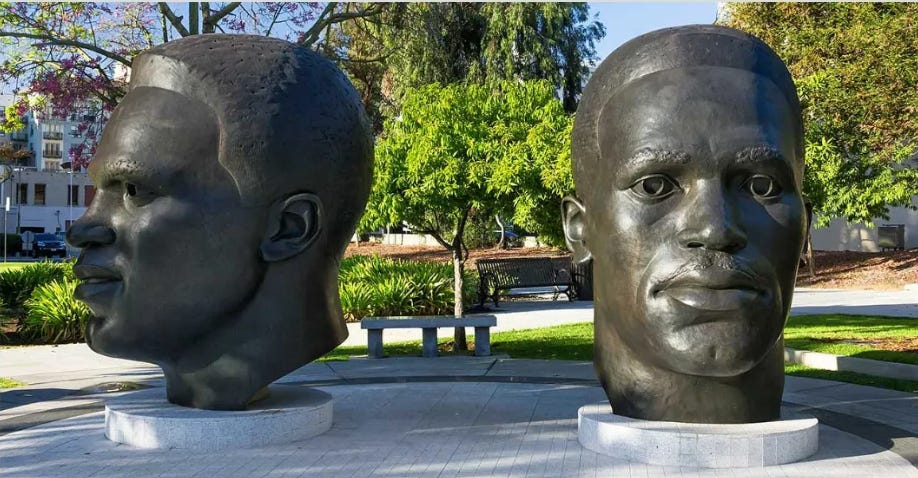
If you go to the Pasadena, California City Hall building you will find the two imposing 9 foot statues pictured below.
The one on the left bears the image of Jackie Robinson and is facing toward the northeast in the direction of Brooklyn where he became world famous for breaking the color barrier in baseball in 1947, and leading the Dodgers to 6 pennants, and a World Series championship in 1955.
The one on the right faces the city hall building and honors Jackie’s older brother, Mack Robinson.
Wait! Mack Robinson? Who’s that?
In this article you will find out.
BERLIN OLYMPIC STADIUM - August 6, 1936
I’m here virtually in Berlin 90 years ago to experience the track & field events at the 1936 Olympics.
NOTE From the Present:
It’s a strange thing taking a virtual trip to Nazi Germany.
I feel compelled to note that on this virtual trip I’m covering the sports that took place in the Berlin Olympics, and not commenting on the atrocities that occurred in Nazi Germany in the coming years. But I will address that in the postscript.
Now back to 1936.
"Yesterday” was the big day in Mack Robinson’s life.
But before we get to yesterday, I need to share a little background.
Here in 1936, Jackie Robinson, at age 17, is a superstar multi-sport high school athlete.
Jackie lettered this year in baseball, basketball, football and track, and outside of school he was a champion junior tennis player too!
In April, 1936, Jackie stole home twice during the Pomona baseball tournament and was selected for the all-tournament team along with Ted Williams.
But despite all that, here in 1936, Jackie is NOT the biggest star athlete in his family. He is a distant 2nd to his older brother Mack.
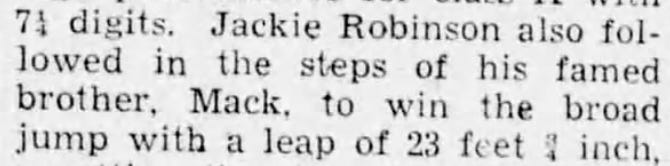
Mack Robinson, who turned 22 a few weeks ago, is the most famous athlete in the Robinson household in Pasadena, California. And newspapers haven’t been shy about letting readers know it, as you can see in the clipping below from the Pasadena Star-News on April 18, 1936, which reported on Jackie Robinson winning the broad jump in the Southern California high school championship:
Meet Mack Robinson
Mack Robinson rose to fame by winning the California High School 100 yard dash championship in 1934. And this spring, in 1936, he was a star on the Pasadena Junior College track team.
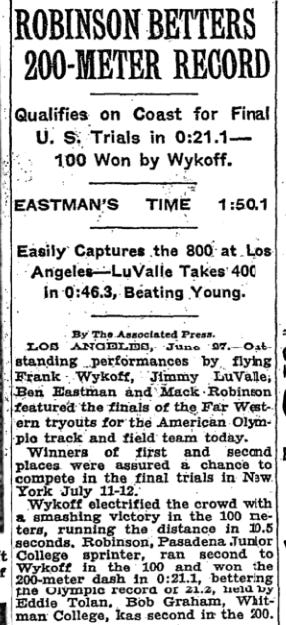
But it wasn’t until the end of June, that Mack Robinson rose to national prominence for the first time. He did so with a bang by breaking the unofficial world record in the 200 meters on a curve with a time 21.1 seconds in the Far Western Olympic Trials Qualifying Track Meet in the Los Angeles Coliseum. His time was 0.1 seconds faster than Eddie Tolan’s gold medal winning performance in the 1932 Los Angeles Olympics on the very same track.
Here is how it was reported in the June 28, 1936, New York Times:
NOTE From The Present: It was an unofficial world record because prior to 1951 there were no official records for the 200 meters on a curve (half a lap on a 400 meter track). This was in spite of the fact that the 200 meters on a curve was a standard event in the Olympics since 1900.
Now back again to 1936.
While Mack Robinson was now a world record holder (albeit unofficial), one other track star had run the same time of 21.1 seconds for the nearly identical distance, the 220 yard dash on a curve. That man was the world’s most famous track athlete - Jesse Owens.
Jesse Owens had catapulted to celebrity status the year prior when in a 45 minute stretch on May 25, 1935, running for Ohio State University in the Big 10 Championship Track Meet, he had set 3 world records and tied a 4th in just 45 minutes.
Now in 1936, just a month before Mack’s 21.1 in the 200 meters, Owens clocked his 21.1 in the 220 yard dash at the 1936 Big 10 Championship.
And this set up a showdown at the United States Olympic Trials in New York City on July 12th.
In the 200 meter final at the Olympic Trials, The New York Times reported that, “as the field hit the straightaway (Ralph) Metcalfe was ahead. Then… Mack Robinson… galloped past him. But in the last forty yards a vivid streak of scarlet came bounding out of the field to win by two feet.”
Jesse Owens was wearing the scarlet and gray uniform of Ohio State. He won the 200 meter trial in a new unofficial world record of 21.0. Mack Robinson took 2nd in a time of 21.2.
The Pasadena Post ran this photo of the finish showing just how close it was. Mack is on the far left with the “P” for Pasadena Junior College. While Owens on the far right is in the Ohio tank top.
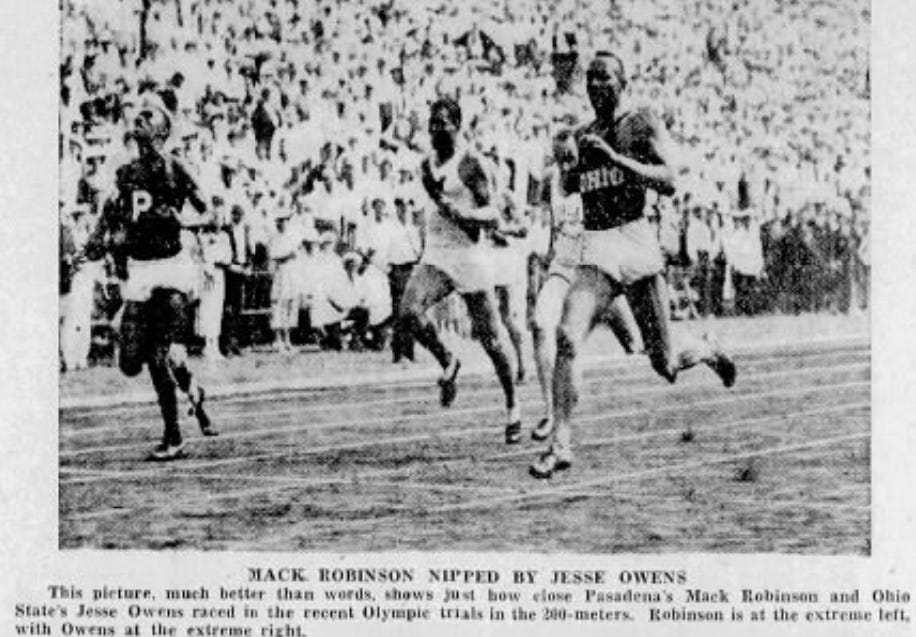
Mack Robinson had made the Olympic team! And he had nearly beaten Jesse Owens. Together they would be headed out of New York City on an ocean liner with the rest of the USA team headed to Berlin for the 1936 Olympics
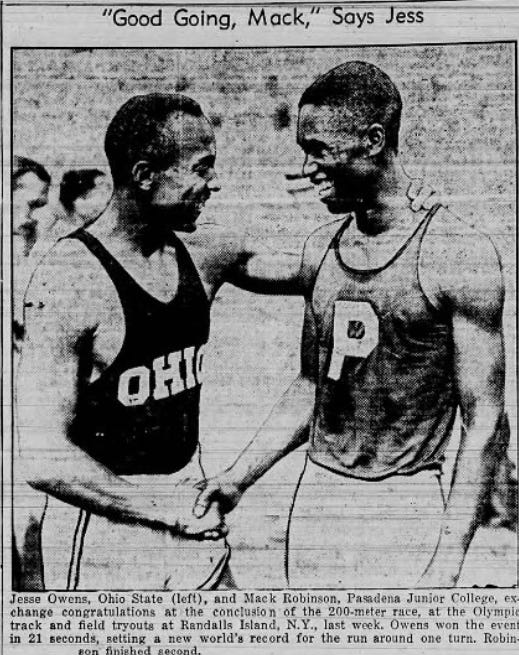
A very happy Mack Robinson was pictured with Jesse Owens after the race in the Afro-American, a Baltimore newspaper on July 18th.
Mack’s Shoes Aren’t Fit
When Mack arrived in Berlin he had a problem. He couldn’t afford to buy a new pair of spikes. His spikes were old and worn out. They were the same spikes he had worn during the 1935 track season. And none of the coaches helped Mack Robinson get a new pair of spikes.
NOTE From the Sports Time Traveler
I have once again come back to the present to share with you an article I found in The New York Daily News on February 23, 1997, in which an 83 year old Mack Robinson recalled the 1936 Olympics, “I had to run in the same old shoes I’d worn in JC meets (Pasadena Junior College) The spikes were barely nubs.”
Jesse Shoes are State of the Art
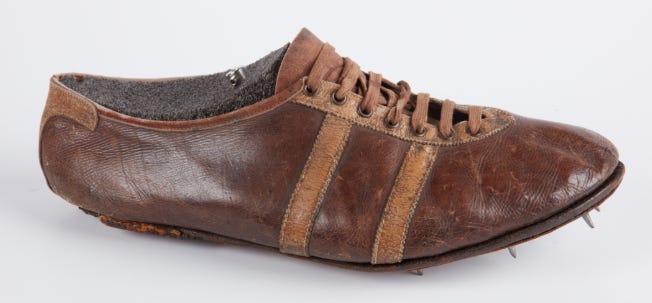
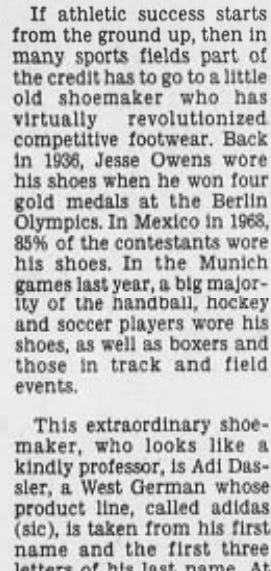
Meanwhile, Jesse Owens, who experienced the type of fanfare in Berlin consistent with his worldwide celebrity status, received a gift of a prototype pair of ultra lightweight spikes from the future founder of Adidas, Adi Dassler, shortly after his arrival in Berlin. Although there is no newspaper accounts of the gift at the time it was made in 1936, there is plenty of evidence to support the story’s truth. One of the shoes is actually on display at the Olympics Museum in Lausanne, Switzerland:
Jesse Owens's shoe worn in the 1936 Olympics
Further corroboration of the story comes directly from Adidas. This article about Adi Dassler appeared in the May 26, 1973 Cincinnati Enquirer:
Jesse Owens had a substantial advantage over Mack Robinson regarding footwear. And on the old style cinder track used in the Berlin Olympic Stadium, this was a major benefit for Owens.
Now back again to 1936.
The Heats and Quarterfinals on August 4th
Jesse Owens won heat number 3 in the 1st round by nearly 5 meters, and in doing so broke the Olympic record and tied Robinson’s unofficial world record with a time of 21.1 seconds.
Mack Robinson, running in the 8th and final 1st round heat, won by nearly 5.5 meters in a 21.6 seconds.
In the quarter-finals, Owens again drew the 3rd heat, and he won it with another 21.1 seconds, again tying the unofficial world record first set by Robinson in Los Angeles in June, and winning by over 6 meters, an extraordinary gap.
In the 4th and last quarter-final heat, Mack Robinson ran 21.2 to tie the old Olympic record set by Eddie Tolan in the 1932 Olympics. Robinson just barely beat Martinus Osendarp of the Netherlands. Osendarp had won the bronze medal in the 100 meter dash the prior day.
The Semi-Finals - 3pm on August 5th
Running in the 1st of the 2 semi-final races, Mack Robinson won his 3rd consecutive race in Berlin, by 2 meters over Lee Orr of Canada. Robinson’s time equaled his world record of 21.1, and matching what Owens had run the prior day.
In the 2nd semi-final, Owens also won by 2 meters, over Martinus Osendarp, but in a slower time of 21.3.
This set up a fascinating final.
The Final - 6pm on August 5th
You can watch the final on YouTube starting at the 2:22 mark on the tape at this link:
Jesse Owens was in lane 3. Mack Robinson is just to Owens’s right in lane 4.
Charles Paddock, a resident of Pasadena, and the greatest American sprinter of the 1920s, was in the Olympic stadium covering track and field events. He wrote in the Pasadena Star News the day after the race, on August 6, “Robinson was off to a wretched start and almost stumbled as he went into the turn. The Pasadena boy did not find himself until he hit the straightaway.”
Paddock also authored an article in the August 6, 1936, Long Beach Sun, in which he wrote this about the start of the 200 meter final, “As the six got away, Robinson’s back hole broke, ruining his start. In spite of that handicap, he still had a fighting chance, and was just coming into his own in the middle of the turn. Then his spiked shoe caught a soft spot in the track, snapping his head back and breaking his form. Precious seconds passed before Robinson was hitting his stride perfectly again.”
Robinson race gamely to the finish line, but he trailed Jesse Owens by about 3 meters.
Jesse Owens took the gold medal in a new Olympic record and unofficial world record time of 20.7 seconds. It was the first time anyone had ever broken 21 seconds for the 200 meters on a curve.
Mack Robinson took the silver medal in 21.1 seconds, equaling his old unofficial world record time for the 2nd time in the day.
Martinus Osendarp won bronze in 21.3 seconds.
And thus, in their only two head-to-head races, in the finals of the Olympic Trials and the Olympic Games themselves, Jesse Owens had defeated Mack Robinson. And it took a world record by Owens both times to do it.
Charles Paddock summarized what happened to Mack Robinson, “A soft spot in the track… cost him the race and his name in the Olympics becomes for all time to come forgotten… If he had gotten off to a good start and run the turn in his accustomed manner, Owens in all probability would not have garnered his third Olympic crown.”
Charles Paddock was highly regarded in the world of track and field, and once considered the world’s fastest human. He was an American hero, winner of the gold medal in the 100 meters in the 1920 Olympics, and winner of the silver medal in the 200 meters in both the 1920 and 1924 Olympics. And he was a first hand witness to the race. I have to trust Paddock’s account of the race.
On the tape, the start for Mack Robinson looks clean to me, but the tape is fuzzy. And there are several seconds on the turn where we can’t see Robinson at all.
As a result, I can’t dispute Charles Paddock’s account of the race.
And the known facts are that Robinson was running in old shoes, with worn out spikes, while Owens was wearing possibly the most advanced track shoes ever created up to that time.
The headlines in America’s newspapers on August 6 all belonged to Jesse Owens, for in capturing the 200 meters he had not only set a new world record, and blasted the 20 second barrier, he had also taken home his 3rd individual gold medal of the 1936 Olympics, solidifying his legacy for all-time.
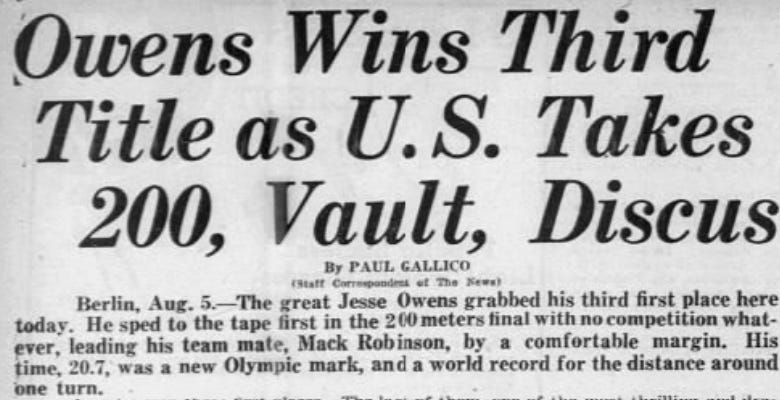
Here was how the great New York Daily News sportswriter Paul Gallico started his article:
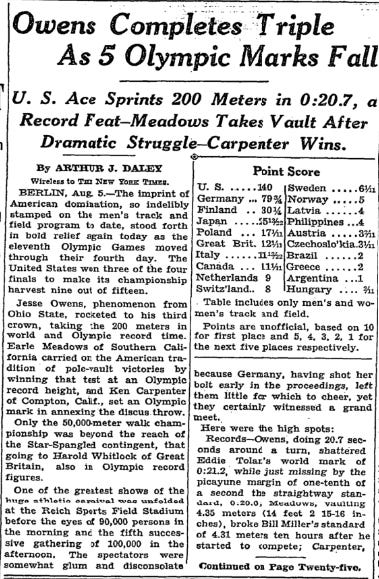
The front page article in the New York Times celebrated Jesse Owens and made no mention of Mack Robinson:
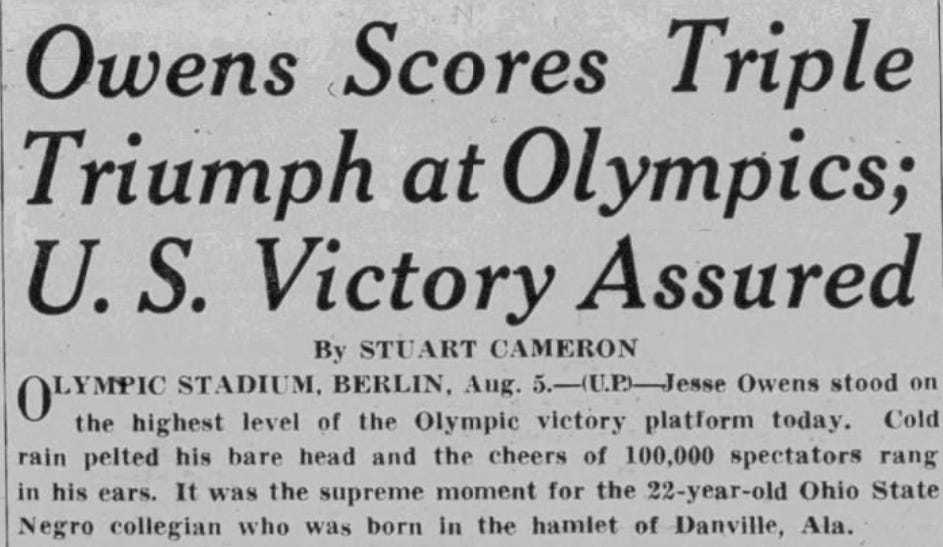
Even the Los Angeles Daily News, in the same metropolitan area as Robinson’s home town of Pasadena, didn’t include the name Mack Robinson, now the 2nd fastest man ever in the 200 meters, in the opening paragraphs of their front page article:
POSTSCRIPT 1 - Homecoming and Record Setting
Mack Robinson returned home to Pasadena on September 7, 1936 to some fanfare.
Below is his picture on the front page of the September 8, 1936 Pasadena Star-News.
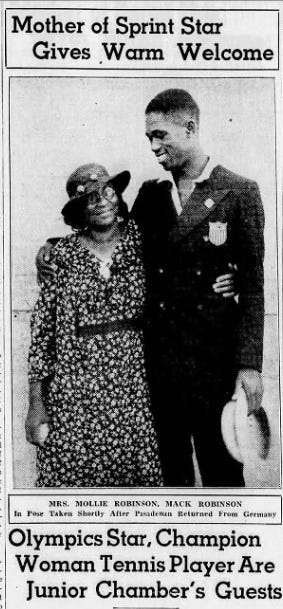
The first paragraph of the article notes that the Pasadena Junior Chamber of Commerce paid tribute to him at their Fellowship Luncheon. Mack sat next to his coach at Pasadena Junior College during the luncheon.
But there was little else after that in terms of homecoming celebration.
The next spring he resumed his track career at Pasadena Junior College and set national set national junior college records in 3 events:
9.6 seconds for the 100 yard dash
20.9 seconds for the 220 yard dash
25 feet 5.5 inches in the long jump
In the Fall of 1937, Mack went to the University of Oregon on a scholarship. Running for Oregon, he won the NCAA and the AAU National 220 yard championships in 1938.
Hard Times for Mack
After 1938, Mack never ran at a high level again. He married in 1938, and had children in 1939 and 1940. Needing to support his family, he had to take odd jobs involving heavy manual labor.
And the name Mack Robinson as an athlete began to fade into oblivion.
Mack’s Track Legacy
His national junior college 100 yard dash record stood for 15 years until 1953.
His 200 yard dash record stood for 20 years until 1958.
But his long jump record lasted only a single year.
In 1938, Mack’s younger brother, Jackie Robinson, now 19 years old, and attending Pasadena Junior College, jumped 25 feet and 6.5 inches, 1 inch farther than Mack, to set the new national junior college record.
Jackie’s record stood for 18 years until 1956, the year he retired from baseball.
It is a little known fact, that Jackie Robinson’s leap of 25 feet 6.5 inches was the longest jump in the world in 1938.
The Rise of Jackie Robinson
The same month in 1938 that Jackie had his world best long jump leap, he was named the baseball MVP for all Southern California Junior Colleges.
The baseball accolade, not the record long jump, inspired sports columnist, Bob Foote of the Pasadena Star-News on May 2, 1938, to write this in his column titled, Foote Loose:
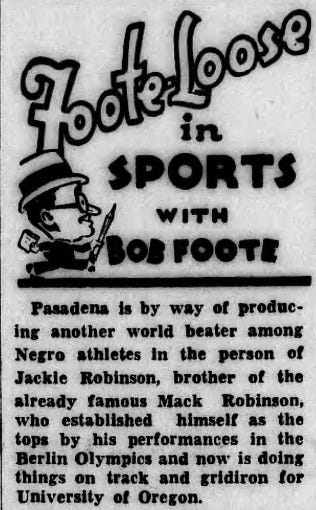
And so this was the beginning of Jackie surpassing his brother Mack as the star athlete of the Robinson family.
Later in that same Foote Loose article is one of the most incredible passages I’ve ever come across in terms of historical ironies:
“Now here is one of the tragedies of sports - if Jackie Robinson… were outstanding in almost any game except baseball, he could achieve national and perhaps world honors, but baseball bars members of his race. He is doomed in that sport to be more or less unheard of. Jackie is just about as good in football and may be the next Jesse Owens of the broad jump. So he need not despair.”
Isn’t that astonishing?
Jackie’s March to Fame
Unlike Mack, who had to support his own family, and thanks to the tireless work of his mother Mollie, who single handedly supported the family in Pasadena, Jackie Robinson was able to continue pursuing athletics in college.
In 1939, Jackie transferred to UCLA on an athletic scholarship. While at UCLA Jackie was a four sport star athlete playing baseball, basketball, football and track and field.
His greatest athletic achievement at UCLA was winning the NCAA championship in the long jump in 1940.
In 1942, Jackie was drafted and served until 1944.
In 1945, the Kansas City Monarchs of the Negro Leagues offered Jackie the opportunity to play professional baseball. He hit .376 in 47 games and drew interest from major league executives interested in testing the color barrier in baseball.
The rest is history.
Jackie was signed by the Brooklyn Dodgers and started his celebrated career in the major leagues in 1947.
Mack Forever Second to Jesse and Jack
For the rest of his life Mack Robinson had to live with the knowledge that he was second to Jesse Owens in the Olympics and second to Jackie Robinson in athletic achievement in his own family.
I hope he took consolation in the fact that those were two of the biggest names in sports history. In ESPN’s rankings of the top North American athletes of the 20th century, Jesse Owens was #6 and Jackie Robinson was #15.
POSTSCRIPT 2 - My Trip to the Berlin Olympic Stadium
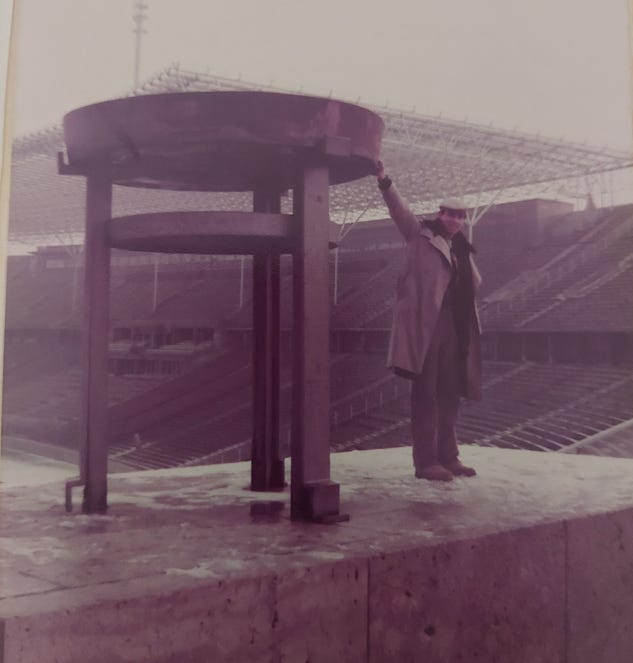
As a lifelong track athlete and Olympics history fan, I was intrigued at a young age about Jesse Owens, Mack Robinson and the other sprinters on the American team at the 1936 Olympics. So when I was backpacking through Europe in 1983, I convinced the group of friends I was with to visit the Berlin Olympic Stadium.
At the time, the stadium looked almost exactly as it did in the videos I had seen of the 1936 Olympics.
We were there on a cold day in December, and we were the only ones there.
It was surreal. We were able to just walk anywhere we wanted and explore the massive stadium. In the picture below, I pretend to be lighting the Olympic flame.
It was an eerie visit. And the fact that it was deserted made it even stranger.
The athletes in 1936 could not conceive of the dark times and atrocities to come in Nazi Germany. But my group of friends were painfully aware, and had already visited a concentration camp.
This trip to the Berlin Olympic Stadium was our way of paying tribute to the American athletes from 1936. Although America did not enter the war until 1941, the American track athletes in essence struck the first victory for America in WWII by destroying the Nazi myth of Aryan supremacy.
FINAL NOTE From The Sports Time Traveler
In the beginning of this article I mentioned that Jackie Robinson was named to a high school all star baseball team when he stole home twice in a tournament in 1936.
Stealing home is one of the most unique, daring and dramatic occurrences in baseball.
19 years later, in game 1 of the 1955 World Series, Jackie stole home in one of the most thrilling moments of that series.
It’s the only time in the last 105 years that a player stole home in the World Series (that was not part of a double steal).
In another little known fact, Jackie Robinson is the baseball leader in total steals of home over the past 100 years with 19.
I tell the story about Jackie Robinson’s steal of home in the 1955 World Series in my new book, THE 1955 BROOKLYN DODGERS - MY DAD’S TEAM.
You can find THE 1955 BROOKLYN DODGERS - MY DAD’S TEAM on Amazon or get a personalized, autographed copy on ETSY at these links:
https://www.amazon.com/stores/author/B07JCC1Q7H/allbooks
https://www.etsy.com/shop/SportsTimeTravelerUS