

NOTE to email subscribers - you can have the best reading experience by viewing this article on www.sportstimetraveler.com
YANKEE STADIUM - October 11, 1926
The Sports Time Traveler made a virtual trip precisely 100 years back in time to experience the 1926 World Series.
What a trip it was! Here’s my report.
The combatants were the New York Yankees and the St. Louis Cardinals.
The Yankees had easily won their 4th American League pennant of the decade, while the Cardinals won a hard fought season long battle to capture their 1st National League pennant since they were part of the American Association in 1888.
Each team is led by a legend
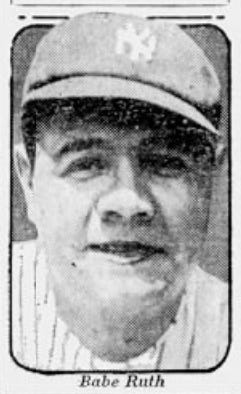
The Yankees of course had the Bambino, the Sultan of Swat, 31-year-old Babe Ruth. Ruth made a sensational comeback in 1926, after his famous “belly ache heard round the world” sidelined him for much of 1925.
His 47 four-baggers in the 1926 season accounted for 11% of all the home runs hit in the league. His 153 RBIs were the best in baseball by a wide margin. And with a .372 batting average, he came with .006 points of capturing the triple crown.
Had the Tigers’ Heinie Manush gone 3 for 9 instead of 6 for 9 in a final day doubleheader, then Babe Ruth would have won the triple crown.
The Rajah
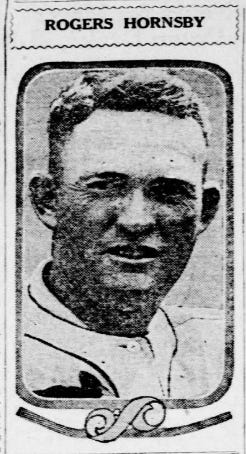
The Cardinals had player-manager Rogers Hornsby often referred to as “The Rajah.” The 30-year-old 2nd baseman had an “off season” batting .317 and driving in 93 runs. It paled in comparison to his other worldly output of the prior 5 years in which he averaged over .400!
The Cardinals Are the Sentimental Favorites
Sentiment outside of New York favored the Cardinals. Not only were they the underdog, and playing in their first modern World Series, but Hornsby had just lost his mother. And her dying wish was for him to play and win the World Series. Her body was lying in wait in Texas until after the World Series.
The First of Many Records
Game 1 of the 1926 World Series was held in the vast confines of Yankee Stadium, the House that Ruth Built.
The 1st record set in the series happened before the game even started, when Graham McNamee spoke these words into his microphone to begin the 1st ever national radio broadcast of a World Series game, “We are just about to go on. The umpire is behind the plate now putting on his mask and adjusting his chest protector. The diamond and the ground and everything look beautiful. The dark brown chocolate color of the base line and the beautiful ground is wonderful. Around the edges of is a running track and still around that is an embankment of green.”
McNamee’s description was heard via a network of dozens of radio stations receiving the live voice over phone lines and broadcasting them to approximately 15 - 25 million people. Never before had a baseball game been listened to live across America, although it was not truly a national broadcast as some areas did not have a station participating.
Game 1
The big name players came through in the 1st game. In the bottom of the 6th, Babe Ruth singled, and Lou Gehrig drove in the Babe to break a 1 - 1 tie, with what turned out to be the winning run.
23 game winner Herb Pennock went the distance for the Yankees allowing just 3 hits. It was only the 2nd time this year that he pitched a complete game 3-hitter.
Ruth, Gehrig and Pennock were the heroes on this day.
A Memorable Moment
While Babe Ruth didn’t hit a home run, he still gave the Yankee Stadium fans a uniquely memorable moment. In the 3rd inning, Babe Ruth was on 1st base and raced to 2nd when Bob Meusel hit a grounder back to Cardinals’ pitcher Bill Sherdel. Sherdel threw to 1st to get Meusel, as Ruth slid safely into 2nd.
Graham McNamee described the scene on the radio after the play, “Babe Ruth possibly having grown a bit in the past few days has split a part of his accoutrements which he needs much in the game of baseball. Babe is the color of a nice red brick house.”
Ruth, one of the most bombastic characters ever to grace the diamond, was literally guilty of being too big for his britches. His pants had split wide open. The game had to be stopped so they could be sewn up.
When the tailor completed the job, McNamee told the audience, “He has gone back to second base, having been sewn up, and the game continues, because trousers or no trousers, we will have a world’s series.”
Game 2
Before the game began there was already another World Series record set. With a paid attendance of 63,600, it was officially the largest crowd ever to see a World Series game up to this time as noted in the New York Daily News.
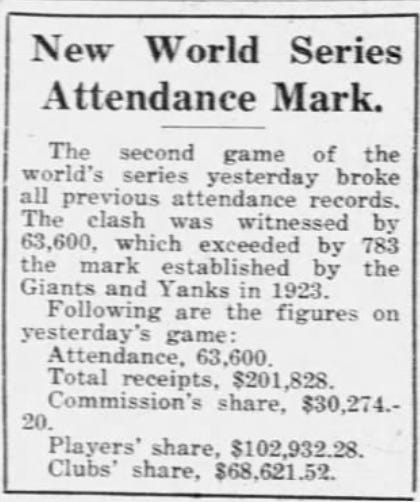
Grantland Rice in his nationally syndicated column called it, “The greatest crowd that ever paid to see a ball game since Abner Doubleday first had his ancient dream.”
The Pitchers
The Yankees sent out their #2 starter, 19 game winner Urban Shocker to the mound. That was no surprise.
The logical choice for Cardinals’ manager Rogers Hornsby was 25-year-old Flint Rhem, the Cards’ only 20 game winner in 1926.
But Hornsby had his own shocker in mind. In a huge gamble for this must win game, which the Cardinals needed to avoid going into a 2 game deficit, Hornsby picked “Old Pete,” the veteran 39-year-old Grover Cleveland Alexander.
Starting Grover Cleveland Alexander was not just risky, it set yet another record. When Alexander threw his 1st pitch in the bottom of the 1st inning to the Yankees’ centerfielder Earle Combs, he became, at age 39, the oldest man ever to start a World Series game by 2 years.
Background on Grover Cleveland Alexander
Grover Cleveland Alexander in his prime was among the top 10 pitchers in baseball history.
From 1911 to 1917, pitching for the Phillies, Grover Cleveland Alexander had a 7 year stretch as good as any pitcher ever, including 3 consecutive seasons of 30+ wins and an ERA never higher than 1.83.
In 1916, he set the record of 16 shutouts in a single season. No one has ever approached that mark.
Then he was drafted and served on the front lines in France during World War I. He was exposed to mustard gas, experiencing severe physical and psychological injuries, hearing loss and shell shock.
Yet, he came back. And in 1920, he looked like “The Old Pete,” as he won 27 games and pitched to a 1.91 ERA.
But that was the last of his extraordinary seasons. From 1921 to 1925 his ERA was consistently above 3 and his new team, the Cubs gave up on Old Pete and unceremoniously waived him.
The Cardinals picked him up off waivers in late June of this year, 1926, but in July he looked dreadful with an ERA of 4.14 in 6 starts.
Then in August and September he pitched well, with an ERA of just 2.24 and 2 shutouts, easily the best on the team over the final 2 months.
Now Old Pete, Grover Cleveland Alexander, was being called on to start game 2 of the World Series. It was just the 3rd World Series game of his career, and his first since the Phillies had made it to the World Series in 1915.
Game 2 Begins Badly for the Cardinals
The move by Hornsby to pitch Old Pete was risky. And after Yankees’ leadoff man Earle Combs belted a single to open the 3rd inning, Hornsby’s move was looking like a big blunder. Alexander had already given up 4 hits, a walk, and 2 runs (although 1 run was unearned) in just 2 official innings of work.
And then something magical happened.
Old Pete reverted to his former self.
He threw masterfully again.
He left Combs stranded on 1st base as he retired the next 3 batters to close out the 3rd.
In the 4th inning he struck out the side, including Lou Gehrig and Tony Lazzeri.
In the 5th it was another 1-2-3 inning.
In the 6th, he got Ruth to ground out and Bob Meusel to strikeout looking to end another 1-2-3 side.
In the 7th, it was 3 consecutive ground outs.
He retired the Yanks in order yet again in the 8th.
Meanwhile the Cardinals had tied that game at 2 all in the 3rd, and in the top of the 7th, a home run by right fielder Billy Southworth put them ahead.
In the bottom of the 9th, with the Cardinals up 6 - 2, the heart of the Yankees order, their 2, 3 and 4 hitters were due up.
Shortstop Mark Koenig grounded out.
Old Pete vs. the Babe
Now Babe Ruth stepped in. Ruth was 0 for 3.
Graham McNamee told the radio audience that the crowd was yelling, “Give up a home run, Babe.”
Then Ruth drilled a shot. McNamee described the play, telling listeners that the Babe, “drove it to Hornsby who makes the prettiest catch of the series so far. A line drive, and it was a fast one, and Hornsby took it with his glove hand as he was running to his left. It was a peach.”
Then Old Pete had one last batter to retire. It was Bob Meusel, the clean up hitter, who had led the American League with 33 homers last year when Ruth was ill. On the 2nd pitch he grounded to short. Tommy Thevenow threw to 1st baseman Jim Bottomley and the game was in the books.
Old Pete had been magnificent. He had retired the last 21 Yankees in a row to win the game for the Cardinals and tie the series at 1 all. Only 1 of those 21 Yankees’ hitters had even had a ball leave the infield. And that 1 was, “a dinky fly to left,” according to Grantland Rice.
Old Pete’s Pitching Masterpiece
And his feat was immortalized by Grantland Rice the next day as he wrote, “The seven-inning finish of Alexander, after a rocky and labored start, was one of the pitching masterpieces of all time. It was sheer art raised to the zenith, for it came from an arm grown old in many wars, an arm that by now should be withered and stale.”
Grover Cleveland Alexander became an instant legend in the great baseball town of St. Louis.
J. Roy Stockton of the St. Louis Dispatch wrote this to start his article on the game, “Blazon forth the names of Grover Cleveland Alexander and William Southworth. The letters can’t be too large and the lights can’t be too bright.”
Above the article was this headline of Grover Cleveland Alexander’s great achievement:

Another interesting note is that in striking out 10 Yankees, Alexander registered more strikeouts in that one 9 inning game than he had in his last 38 innings of the season.
NOTE from The Sports Time Traveler
I’ve come back to the present to inform you that Grover Cleveland Alexander’s 21 consecutive batters retired in a single World Series game set a World Series record.
And it remained the World Series record for 30 years until Don Larsen threw the only perfect game in post season history in 1956.
100 years later, no pitcher has ever retired last 21 batters in a World Series game besides Alexander and Larsen.
Now back to 1926.
Meet Me in St. Louis and Another Record
With the series tied at 1 game apiece the 2 teams took the long train ride to St. Louis. Since the Cardinals had never been in the modern World Series, this was the 1st time that teams had to travel such a vast distance between games, as St. Louis was the farthest western city of any major league baseball team.
Now the on field competition went off field to see which team could get to St. Louis fastest.
The New York Times reported in a front page story, “Rushing across Indiana and Illinois at 72 miles an hour, the Yankee Special on the New York Central thundered into Union Station here (in St. Louis) at 3:40 o’clock Central Standard Time, setting a new railroad record between New York and this city.”
Not only had the Yankees set a new record but they also beat the Cardinals as the Times further reported, “The Yankees’ special had pulled into Union Station ten minutes before the Cardinals.”
The Yankees’ train had set the record for fastest train trip from New York to St. Louis covering the distance in 23 hours and 25 minutes to break the old record by 15 minutes.
The Cardinals Arrive to a Hero’s Welcome
Even though they lost the train race, when the Cardinals arrived in their hometown it was to a city that was deliriously happy to host their 1st modern World Series as games 3, 4 and 5 would be played in St. Louis.
The enormous pent up enthusiasm for the team stemmed from the fact that the Cardinals had been on the road for 5 weeks. The Cardinals played their final home game of the season on September 1st, followed by 24 consecutive games on the road to close out the season, and then 2 more games in the World Series at Yankee Stadium. It’s hard to conceive of such a schedule in our present time.
This had the effect of creating a frenzy perhaps never seen before for a baseball team.
A parade was held after the Cardinals disembarked the train at 4:15pm in St. Louis. The St. Louis Dispatch reported, “Mayor Miller today ordered all city offices to close at 3pm.” Other businesses let their workers off during the parade.
A picture of the Parade appeared on the front page of the St. Louis Star.
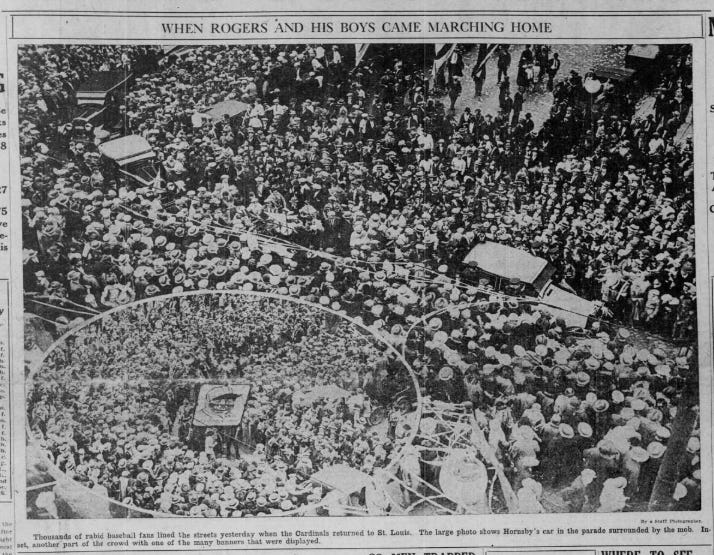
The historical significance of the 1st modern World Series game ever played in St. Louis was not lost on anyone covering the game. James M. Gould of The St. Louis Star wrote this on the morning of the game, “This is the ‘day of days” in the history of St. Louis sport.”
Considering St. Louis had hosted an Olympic Games in 1904, that’s pretty heady stuff.
Game 3
Sportsman’s Park in St. Louis was buzzing before the first modern World Series game ever played in St. Louis began. And it wasn’t just the fans that were buzzing. Graham McNamee on the radio reported during the 1st inning about an airplane flying constantly just above the stadium, “Boy, that plane is right down here. I think you can hear the hum of it. It is only about 100 feet over the roof of the stand.”
In the 2nd inning he said, “Everybody is watching the plane for the moment, not watching the teams at all. He is simply floating. Now he is starting his engine again… It is awfully hard to keep our eyes off the marvelous work that airplane driver is doing with his plane… but it seems to me it is mighty dangerous right over a ball park.”
It is estimated that at least 15 million people and possibly as many as 25 million people heard the radio broadcast and the descriptions of the airplane, but no other newspaper accounts I can find mentioned it.
Fans in St. Louis who watched the game and not the plane saw Jesse Haines, a righty Cardinals’ pitcher with a 13 - 4 record in 20 starts during the season have the game of his life. While he gave up 3 singles to Ruth and Gehrig, he allowed just 2 hits to the rest of the Yankees (both singles), and threw a 5-hit shutout. In addition, Haines supplied half of the run production for the the Cardinals with a 2-run homer. The Cardinals won it 4 - 0 to take a 2 games to 1 lead.
Game 4
Now the tables had turned and it was the Yankees who were desperate for a win lest they fall behind 3 games to 1.
Rogers Hornsby finally pitched his 20 game winner, Flint Rhem, and Rhem got rocked in the top of the 1st as Babe Ruth sent a ball out of the park for a homer, his 1st of the series and the 1st for the entire Yankees team.
John J. Sheridan of the St. Louis Globe-Democrat described the homer, “A tremendous clout that hit the back of the roof covering the extreme right wing of the grandstand and rolled onto Grand Boulevard.”
The Cardinals came right back and tied it up at 1 - 1 in the bottom of the 1st when Hornsby drove in a run.
And then Ruth came up in the 3rd inning and rocketed Rhem’s 1st pitch. McNamee said on the radio that the ball was hit, “just about as hard as Ruth or any one else ever hit… What a shot that was.”
Here’s how Sheridan described this one, “Babe came back with one hit harder and longer in the third inning. This was a line drive that landed on Grand Boulevard, clearing the right centerfield pavilion roof.”
Ruth’s 2nd homer put the Yankees back in front 2 - 1.
But the Cards came back again and held a 4 - 3 lead after 4 innings.
Then the Yankees erupted for 4 runs to take a 7 - 4 lead with Ruth scoring one of the runs when he walked and was later driven in by Tony Lazzeri.
Ruth came up again in the 6th inning with 1 out and a man on 1st base and the score still 7 - 4 Yanks. Now with Ruth facing a new Cardinals’ pitcher, Herman Bell, McNamee described the scene. “Babe’s shoulders look as if there is murder in them down there, the way he is swinging the bat.”
After taking a ball, Ruth fouled one into the left field stands. Then he fouled off another one. With 2 strikes, the next 2 pitches were balls and now the count was full.
The Payoff Pitch to Ruth
On the next pitch Ruth swung and Graham McNamee yelled, “Oh, what a shot!… far into the bleachers out in center field… Wow! That is a world’s series record, three home runs in one world’s series game, and what a home run! That was probably the longest hit ever made in Sportsman’s Park.”
John J. Sheridan of the St. Louis Globe Democrat wrote about Ruth’s 3rd home run of the game. After noting that Ruth’s first 2 homers both ended up on Grand Boulevard he went on to say, “Both of these, however, resembled Texas leaguers compared to the big Bam’s third homer in the sixth. It was a wallop that did not stop until it rested in the lap of a customer in dead center field, one of the longest if not the longest blows ever seen at Sportsman’s Park.”
Grantland Rice, in his nationally syndicated column, had this to add, “His third home run was practically a line drive, yet it was still moving at hurricane speed when it crashed into the crowd on the seats 450 feet from the plate. It certainly would have traveled more than 500 feet before hitting the ground if there had been no stand.”
The 2-run homer completely broke open the game as the Yankees went ahead 9 - 4 and eventually won it by a score of 10 - 5.
Remember Ruth is a Great Hurler Too!
Wilbert Robinson, the manager and president of the Brooklyn Dodgers, was in the stadium and wrote this about Babe Ruth in a New York Times article, “He also cut off a run at the plate for the Cardinals in the fourth inning with a wonderful throw from deep left field, and this, I believe ought to make old Babe a world’s series hero nobody should ever forget.”
Babe Ruth, the Sultan of Swat, had risen to the occasion just when the Yankees needed him to. The World Series was now tied again at 2 games apiece.
The Babe’s Promise to a Sick Boy
The New York Daily News had an additional piece of news about the game that appeared on the front page of the newspaper. It showed a young boy, Johnny Sylvester, holding an autographed baseball from Babe Ruth. Sylvester was facing a life threatening illness and Babe Ruth and Rogers Hornsby had mailed the boy autographed baseballs.
The front page of the Daily News had this caption underneath the picture: “When Johnny Sylvester of Essex Fells, NJ was in shadow of death he had one wish - that Babe Ruth would knock a homer Wednesday (which was the day of game 4). By air mail Babe and the Cards sent autographed balls. Babe inscribed his pledge to make a homer. The Bambino made good - thrice over. Doctors said that the baseballs saved Johnny’s life.”
Game 5
There were no great fireworks in the 5th game which was a pitcher’s duel between Herb Pennock, the winner of game 1, and Bill Sherdel, the game 1 loser who had pitched well in the opener.
Going into the 9th inning of game 5, the Cardinals led 2 - 1. Lou Gehrig doubled and scored minutes later to tie the game and the contest went into the 10th.
In the top of the 10th, the Yankees loaded the bases and Tony Lazzeri drove in a run on a sacrifice fly. Pennock got the Cardinals out in the home 10th and the Yankees had a come from behind victory by a score of 3 - 2. In doing so, the Yankees took a 3 games to 2 lead as the World Series headed back to New York.
The Great Train Race Back to New York
Now the 2 teams took the long train ride back to New York where game 6 and a possible game 7 would be played in Yankee Stadium.
This time it was the Cardinals that set a record for fastest trip ever from St. Louis to New York.
The front page of the New York Times on October 9, 1926 mentioned the record in this sub-heading:

In the article, Harrison wrote, “If the Cardinals show as much speed today as their special train did yesterday, they will run through and over the Yanks.”
On page 11 of the Times, it was revealed that the Cardinals’ train didn’t just break the speed record, it obliterated it by 2 hours and 40 minutes!
NOTE from The Sports Time Traveler
I’ve come back to the present again to let you know that I checked the train schedules here in 2026, and it takes at least 26 hours to travel from St. Louis to New York City by train. That’s 5 hours longer than it took the St. Louis Cardinals 100 years ago!
Now back again to 1926.
Betting on the World Series
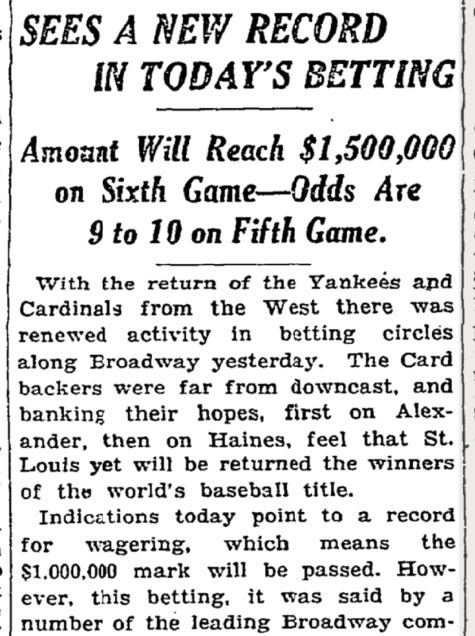
Back again in 1926, I was reading the newspapers on the morning of game 6 and I was surprised to find articles about betting on the game as if it was legal to do so, which it was not.
Just 7 years after the infamous “Black Sox” scandal during the 1919 World Series, betting on games is being conducted out in the open and is sensationalized in the New York Times.
This is so astonishing I have to show it to you. Here’s the beginning of the article on page 11 of the October 9, 1926 New York Times:
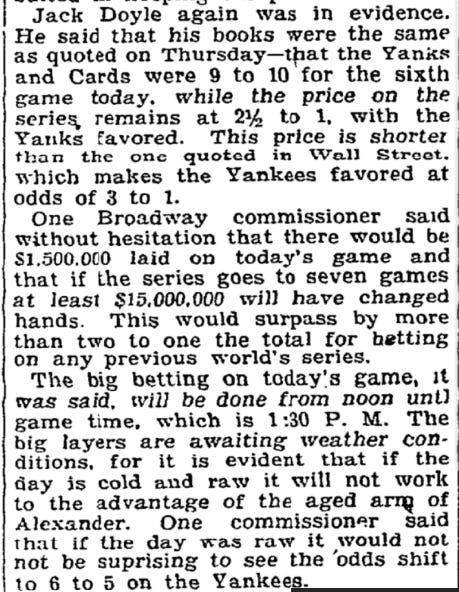
And a little further down they mention the most notorious book maker of the era, Jack Doyle:
Game 6
35-year-old Bob Shawkey, who had been the ace of the Yankees staff long ago from 1916 to 1920, was given the ball to start game 6 for the Yankees, even though he had only started 10 games this season in 1926.
But Shawkey had pitched 3 and 2/3 perfect innings in relief in the series so far. So Miller Huggins gave Shawkey the opportunity to wrap up the Yankees’ 2nd World Series title with a victory.
In the top of the 1st inning, Shawkey got off to a rough start. He gave up a single, a walk, another single and a double, resulting in 3 runs before he struck out a couple of Cardinals to escape what could have been truly disastrous.
Meanwhile Grover Cleveland Alexander, who had somewhat miraculously won game 2, got the nod again from Hornsby and set the Yankees down in order in the bottom of the 1st.
In putting the Yankees down 1-2-3, Alexander extended his World Series record streak to 24 consecutive Yankees batters retired. He was one inning away from a “perfect 9 innings.”
In the bottom of the 2nd, the Yankees 1st batter was Bob Meusel. Let’s look at the radio transcript of McNamee’s call, “Bob Meusel hits a short fly, and it falls safe. Thevenow and Hafey both go after it. Neither one gets to it, and Bob gets a two base hit.”
Then Alexander follows that up by getting three straight ground outs to retire the side.
Oh, So Close!
So, Grover Cleveland Alexander, came oh so close to pitching 9 perfect innings against the Yankees. Just think about that for a second.
The score remained Cards 3 - Yankees 0 after 2 innings.
In the bottom of the 3rd inning, Yankees lead off batter Hank Severeid hit a clean single to center, and thus closed the book on Alexander’s brilliant streak in which he allowed 1 fluke hit and retired the other 27 batters over a 9 innings stretch.
Bob Shawkey settled in after the 1st inning and allowed just 1 more run in the 2nd through 6th innings. Alexander also allowed just 1 run in that span and after 6 innings the Cards led it 4 - 1.
But in the 7th, Shawkey got into trouble and the Cards put up 5 runs. That put the game out of reach and St. Louis tied the 1926 World Series at 3 games all with a 10 - 2 rout.
Grover Cleveland Alexander, the man who had been rescued from waivers by the Cardinals, whose career seemed finished in June when he was dismissed by the Cubs, had now won 2 games in the World Series.
That’s legendary stuff!
And this already thrilling 1926 World Series was now moving to a winner takes all 7th game - a game in which legacies were to be created.
FINAL NOTE from The Sports Time Traveler
To avoid setting another record, this one for longest Sports Time Traveler article ever, I am giving my readers a rest.
The next edition of The Sports Time Traveler will cover game 7 of the 1926 World Series.
Please share your comments on this article.
BOOKS BY THE SPORTS TIME TRAVELER
If you enjoyed this article, explore my books on baseball.
Both of my baseball books have been accepted into the Baseball Hall of Fame Museum Library Collection in Cooperstown.
You can find them on Amazon:
https://www.amazon.com/stores/author/B07JCC1Q7H/allbooks