

BACKGROUND From The Sports Time Traveler
The Sports Time Traveler has been on a season-long trip back in time in 1976, following Julius “Dr. J” Erving, and the New York Nets every day since the pre-season last September.
It’s been an incredible journey, and it’s coming to a climax.
Game 6 of the ABA Finals between the #1 seed Denver Nuggets and the #2 seeded Nets was set to take place on May 13, 1976, at the Nets’ home arena, the Nassau Coliseum in Long Island. Game 7, if necessary, would be back in Denver on May 16th.
Going into game 6, the Nets led the series 3 games to 2.
Julius Erving’s otherworldly play had been the key to the Nets leading the series. Take a look at Ervings’ averages through the first 5 games of the ABA Championship:
39 points per game
13 rebounds per game
5 assists per game
3 steals per game
2 blocks per game
60% field goal shooting
And the Doctor is doing this against a Denver Nuggets frontcourt that is one of the greatest ever assembled in pro basketball history.
David “Skywalker” Thompson, a rookie in 1976, is one of the most prolific scorers and electrifying players of the era. He finished 2nd in MVP voting in his rookie year. In each of the next two seasons, he will contend for the NBA scoring title and be selected first-team All-NBA
Bobby Jones is one of the greatest defensive forwards of the 1970s and 80s. In 1976, Jones was tied for 2nd in MVP voting with David Thompson. He is in the midst of a run in which he will be selected as first-team All-Defense for 10 consecutive seasons.
Dan Issel is the quintessential power forward, now thrust into the role of center on the Nuggets. He is on a run of 7 consecutive all-star appearances, and has averaged as high as 31 points per game in 1972, when he was 2nd in ABA MVP voting. In 1976, he averaged 23 points and 11 rebounds.
All three of the Nuggets’ frontcourt stars will eventually reach the Hall of Fame, making Denver one of the only teams in history with an “All-Hall” frontcourt.
Julius Erving has no such supporting frontcourt cast. The Nets’ starting center is rookie Kim Hughes, who will have a brief NBA career, averaging under 4 points per game. And Hughes is out for the rest of the series.
The Nets’ power forward is undersized Rich Jones, who is only 6’6” and has had a poor season, shooting just 38% and grabbing a paltry 5 boards per game.
Now join me back in 1976.
LONG ISLAND, NY - May 14, 1976
Last night I was at the Nassau Coliseum, home of the Nets, virtually, for game 6 of the 1976 ABA Finals.
Everyone in the building, except the Denver Nuggets, was hoping this would be the last game in ABA history.
There was a bittersweet feeling in the arena. The ABA has been a phenomenal cultural experience over the past 9 years, but now it is coming to an end. Everyone knows the ABA will cease to exist and merge with the NBA during the upcoming offseason.
For the Nets, last night’s game was effectively a game 7, because the Nuggets are almost nearly impossible to beat at home, where the finale is scheduled to be played if the Nets don’t win it now. The Nuggets had a home record of 39 - 3 during the regular season this year, and 40 - 2 in the regular season last year.
Yes, the Nets did win one game in the championship series in Denver, but that was on a game 1 buzzer beater by Julius Erving, after he scored 18 points in the 4th quarter, and it broke a 2-year drought for the Nets in Denver. The Nets had lost their prior 11 games in Denver, going back to the 1974 season.
The bottom line is the Nets simply had to win last night.
Now, join me as we experience last night’s game here in 1976.
You can experience the 6th game of the ABA Finals the way I did by watching this YouTube video of the HBO broadcast of the game. That’s right HBO, which was is in its infancy here in 1976, with less than 400,000 subscribers, had the broadcast of the game.
Here’s my commentary on the game with timestamps from the video provided so you can watch these highlights:
23:30 - Wow! Players are really restricted in what they can do here in 1976. Watch this traveling violation as David Thompson passes the ball to Chuck Williams. The infraction is completely imperceptible to me.
This is one reason why players from the past are often not considered as good as players in the mid-2020s, who have the freedom to do so many more things on the court than their predecessors.
32:20 - See David Thompson steal a pass intended for Dr. J, go behind the back on his dribble, and then get the ball back and hit his patented sky jumper. Thompson is breathtaking to watch.
35:55 - Watch Dr. J get the ball down low and hit a reverse layup. Stick with the tape for another 20 seconds to see another sky jumper by David Thompson
NUGGETS 38 - NETS 29 - early 2nd quarter
36:40 - We’re treated to a super slow-motion replay of Dr J’s earlier reverse layup.
37:25 - Thompson drives baseline and puts up another sky jumper. He now has 19 points here in the middle of the 2nd quarter.
NUGGETS 42 - NETS 31 - mid 2nd quarter
40:40 - Skywalker again! This time on a double pump jump shot. He has 21 in the half, and Denver opens up a 15 point lead.
41:10 - Little Monty Towe, who the announcers said is 5’5” throws a 30 foot alley oop pass to Thompson, who outduels the Doctor for the score. David Thompson has 23 points.
Stick with the tape as the Nets’ Brian Taylor misses a short jumper. Bobby Jones grabs the rebound, feeds Monte Towe, who is off to the races, and hits Jones for a layup.
Denver has opened their largest lead yet at 16 points.
NUGGETS 52 - NETS 36 - mid 2nd quarter
41:45 - Dr. J gets the ball guarded by Dan Issel. But Issel is no match for the Doctor who goes around him for a slam dunk. Stay with the tape to see the Slow-motion replay 30 seconds later.
49:00 - Listen to the announcers while David Thompson is on the free throw line. They describe how Alvan Adams, the NBA Rookie of the Year, said during his acceptance speech, “I’d like to thank David Thompson for going into the ABA.”
Thompson hits the free throw for his 27th point of the 1st half. He is shooting 11 for 13 in the biggest game of his professional career.
NUGGETS 58 - NETS 45 - Halftime
In the 3rd quater, the game continues to be dominated by Thompson and the Nuggets. With 5 minutes to go in the 3rd quarter, Denver extends their lead to 22 points at 80 - 58.
At this point, the Nets call timeout, and coach Kevin Loughery invokes a “Code Yellow" for the Nets.
Paul L. Montgomery describes what this meant in today’s New York Times:
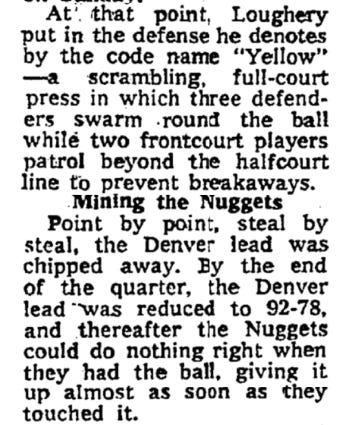
The “Code Yellow” defense helped the Nets cut the lead from 22 to 14 at the end of the 3rd quarter.
At this time, David Thompson has 38 points in the game. It’s a truly remarkable performance for a rookie.
NUGGETS 92 - NETS 78 - End of 3rd quarter
The tape skips ahead to 10 minutes to go in the 4th quarter. The Nets have continued to whittle down the lead, scoring the first 5 points of the quarter to pull within 9.
NUGGETS 92 - NETS 83 - 10 minutes to go
58:40 - The Doctor can do it all. Watch him block a Dan Issel shot.
1:01:25 - The Nets shooting guard, Super John Williamson, who was held to just 4 points in the 1st half, is in the zone. Watch him drive to the baseline, as he’s tracked by 3 Nuggets, and shoot a jumper. Bullseye! The Nets are within 5 points.
1:04:25 - Erving is on the baseline double-teamed by Issel and Jones. He leaps and fires a cross court pass to an open Super John who launches another jumper. Bullseye! Williamson has 16 in the 2nd half.
1:05:10 - The Doctor skies for a rebound, then leads the break and dishes to Super John. Supe has 6’9” Bobby Jones all over him, but he manages to get free and Bullseye! He hits again, and he’s fouled. He hits the free throw and has 19 points in the 2nd half.
NUGGETS 96 - NETS 92 - 10 minutes to go
1:09:10 - Supe is feeling it. On this play he takes the ball inbounds and finds his spot and pops and Bullseye! Williamson has 21 in the half. The Nets have narrowed a 22 point Nuggets lead down to 2 in less than one quarter of game time. Since 5 minutes to go in the 3rd quarter the Nets have outscored the Nuggets 38 - 18.
NUGGETS 98 - NETS 96 - 5:40 to go
1:19:35 - Nuggets’ guard Ralph Simpson, an all-star for his 5th consecutive season, is called for another perplexing traveling call. It’s amazing how limited players are to move in 1970s basketball games.
1:20:20 - Doc has the ball at the top of the key and finds Super John in the far corner. He hoists a long jumper and Bullseye! The Nets have taken the lead after being down by 22 points.
NETS 106 - NUGGETS 104 - 2:40 to go
1:20:20 - Brian Taylor drives and has an open layup, but swooping in is the Human Eraser, Marvin Webster. He delivers a stunning block. Webster, coming off the bench, is yet another force in the Nuggets’ astonishing frontcourt. But goal tending is called and the Nets extend their lead to 4 points.
NETS 110 - NUGGETS 106 - 45 seconds to go
1:27:10 - The Nets lead by 6 points with time running down. Denver is trying for steals and not fouling. With 3 seconds to play Rich Jones makes a layup, and all chaos is unleashed in the Nassau Coliseum. The game is not over, but in a flash, hundreds of fans have stormed the court. The officials let the clock run out. And the Nets have pulled off one of the greatest comebacks in pro basketball history to win the game and the ABA Title!
And as the clock runs out, so does the shining light of the American Basketball Association, for this is the final game in league history.
Today, 50 years ago, the back page of the New York Daily News featured this banner headline:
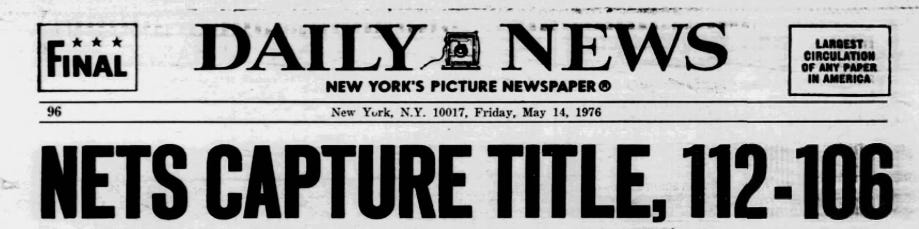
POSTSCRIPT - 1
The Daily News has never again reported on the Nets capturing a title, because in the 50 years since they entered the NBA, the Nets have never won another championship.
But let’s savor the Nets 1976 title a little more.
A strong case can be made that this final ABA Championship crowned not just a league champion, but a professional basketball champion across the ABA and the NBA.
In the preseason, in two fascinating match ups, the Nets beat the team with the best record in the NBA in 1975, the Washington Bullets. And the very next day, they took the 1975 champion NBA Warriors right to the finish in a 5 point loss. In that game, possibly one of the greatest in pro preseason history, Rick Barry scored 49 and Julius Erving scored 43.
During the pre-season Knicks’ guard Walt Frazier was asked by the Staten Island Advance who Dr. J compares to in the NBA. Read Walt’s reply:
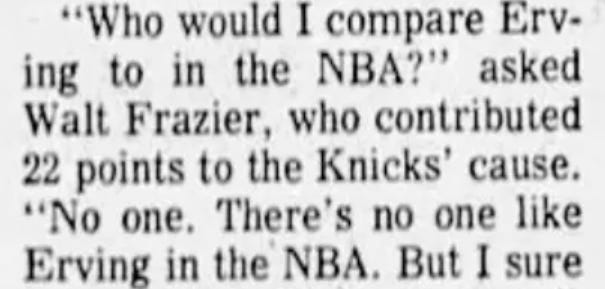
In 1976, neither of the teams that reached the NBA Finals had personnel to match the ABA Finalists.
In the NBA in 1976, the champion Boston Celtics were certainly a powerhouse team. But their frontcourt included aging players John Havlicek (35) and Paul Silas (32) on the backsides of their careers. They did not have the “All Hall” frontcourt of the Denver Nuggets. And in the NBA Finals, the Celtics were taken to 6 games by the Phoenix Suns, a team that barely made the playoffs with a record of 42 - 40.
The personnel playing in the ABA Finals were clearly superior. Virtually all basketball people in 1976 recognized Dr. J as the game’s greatest player.
Denver’s coach Larry Brown, a Hall of Fame coach, who nearly 30 years later led the Detroit Pistons to an NBA title, had this to say about Julius Erving after the 1976 ABA Finals, as reported by Bert Rosenthal of the AP:
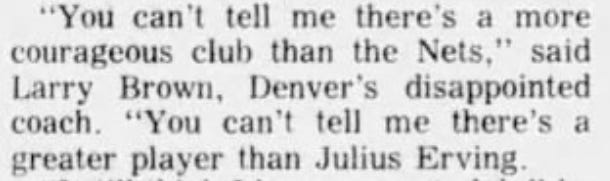
And David Thompson clearly qualifies as a candidate for second greatest player in the game in 1976, particularly after his historic performance in the biggest pro game of his life.
David Thompson finished the game with 42 points, to set a pro basketball record for rookie scoring in a single game in a championship series. That record still stands today in 2026, after being tied by Magic Johnson in game 6 of the 1980 NBA Finals.
In the NBA, the MVP in 1976 was Kareem Abdul-Jabbar. Kareem certainly had a dominant year, but his team missed the playoffs at 40 - 42. Kareem remains the only NBA MVP in history whose team did not make the playoffs.
Super John Williamson finished the game with 28, scoring 24 in the 2nd half, spearheading the Nets improbable come from behind victory. Supe demonstrated his ability to go off on hot streaks. A couple of years later, he would provide me with the most incredible excitement when I listened to Nets’ games on the radio and heard announcer John Sterling repeatedly yell his signature, “Bullseye,” every time Supe hit from downtown.
Super John would go on to average over 20 points per game in each of the next 3 seasons in the NBA.
I was privileged to watch Williamson up close in a stretch of 33 games in 1978. He had been traded back to the Nets, and he promptly averaged nearly 30 points per game, hitting shots routinely that would have been three-pointers several years later when the NBA adopted the ABA’s greatest innovation.
The Nets of course, went from ABA champions to chumps after they sold Julius Erving to the 76ers as the price they had to pay to gain entrance into the NBA.
After the 1978 season, Bobby Jones was traded to Philadelphia, where he would team with Dr. J and take the 76ers on a run of 3 Finals appearances in 4 years beginning in 1980, and culminating in an NBA Championship in 1983 with possibly the most dominating playoff run ever, in which they went 12 - 1, and swept the Lakers in the Finals.
And finally, Dan Issel formed the backbone of a Nuggets team that was a perennial Western Conference powerhouse in the NBA for the next several years, reaching the conference finals in 1978.
POSTSCRIPT - 2
Two days after the Nets won the last ABA Title, on May 15, 1976, the New York Times ran an article with additional insights on the Nets’ historic comeback from 22 points down with 17 minutes to go in the game.
Nets’ power forward Rich Jones told the Times’ Paul L. Montgomery, “It was the Yellow that did it.” Jones was referring to the Code Yellow defense that Nets’ coach Kevin Loughery called when the Nets fell behind 80 - 58 with 5 minutes to play in the 3rd quarter.
In the article, Montgomery explains that back in February, Loughery started experimenting by calling “Code Yellow” in the middle of meaningless games as a way to prepare the team to use it in a critical situation.
And lo and behold, that critical situation came up in game 6 of the ABA Finals, and a well drilled Nets’ team deployed the Code Yellow to perfection as they outscored the ABA’s best team, and possibly the best team in the world, by a shocking 54 - 26 margin over the final 17 minutes of the game, doubling the Nuggets score in that span, to capture the ABA Title.
FINAL NOTE From The Sports Time Traveler
Back here in the present time, I have to tell you this just further proves to me what a brilliant coach Kevin Loughery was.
In 1977, when the Nets moved to New Jersey, I lived just 15 minutes from the arena. And I had the incredible opportunity to go watch every home game for the next 4 years. And that means I studied Kevin Loughery up close.
Kevin Loughery was an incredible coach. He deployed the most innovative offensive and defensive schemes. And he ALWAYS stood up for his players. The most notable thing about Loughery was that he led the league in ejections.
On offense he used a brilliantly devised double pick play in which his two big men would stand down low in the paint as if they were lined up during a foul shot. He would then have his shooting guard, Super John Williamson, stand in the opposite corner of the court while his point guard had the ball outside the top of the key.
As the play began, Supe would dash the baseline and run past the double pick. Sometimes Supe would actually run out of bounds and re-establish himself back on the court. This made it impossible for the man guarding him to stay with him. Once on the other side of the pick, the point guard passed to an open Williamson, and about 70% of the time, John Sterling would be yelling, “Bullseye” on the radio a second later, and loud enough that I could hear him inside the arena.
For nearly 50 years, I’ve wondered why I haven’t seen this play run by other NBA teams.
I also wish to take a moment to remember John Sterling who passed away last week. Long before he became the voice of the Yankees, John Sterling was the voice of the Nets. His patented, “Bullseye!” calls were so exciting to listen to on the radio. I will always miss listening to John Sterling call basketball games.
Now back to coach Kevin Loughery.
On defense, Loughery used to put his two biggest players on the inbound passer late in games when the opposing team was inbounding at midcourt. When you’re the inbound passer, and you have two big guys standing in front of you, waving their arms, and you have to get the ball in play in under 5 seconds, you’ve got a serious problem. And it seemed that more often than not, this resulted in a turnover and the Nets got the ball back.
Again, I’ve never seen another team deploy this approach.
Kevin Loughery made watching the Nets so much fun, even though they had a miserable team after they had to sell Dr. J after the 1976 season to raise the cash needed to join the NBA.
POSTSCRIPT - 3
I’m back once more with another update from the past.
It’s now 3 days since the Nets won the very last ABA Finals. In the New York Times today (5/16/1976) Sam Goldpaper wrote an article about Julius Erving that might help people in the mid-2020s understand why the Doctor might just be the GOAT.
Here are a couple of a few excerpts:
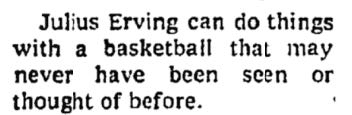
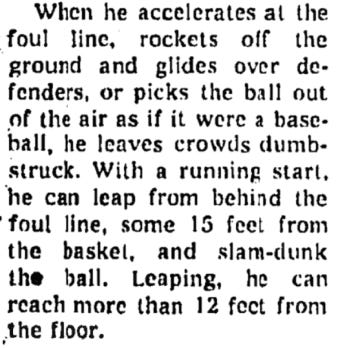
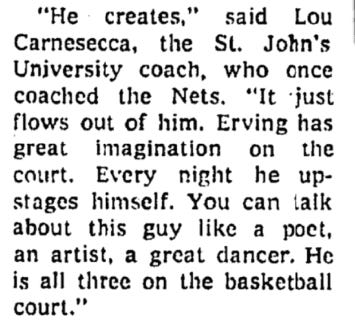
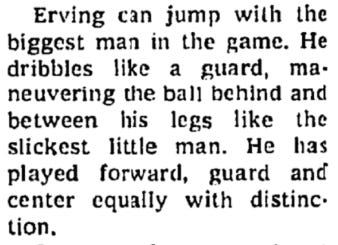
This next one is of particular significance. Julius Erving can play every position on the court “with distinction.” How many pro basketball players have ever done that?
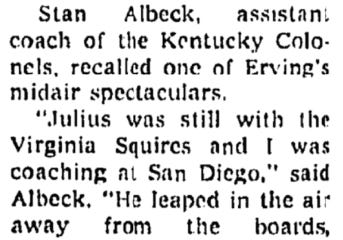
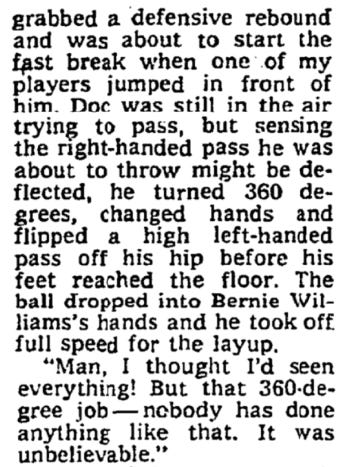
Here’s a short story about a single move that left the great coach, Stan Albeck, completely in awe:
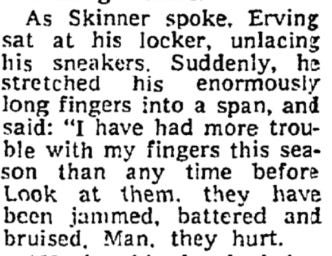
And finally, as someone who saw the Doctor play in both the ABA and the NBA, I’ve always contended that by the time he was in the NBA, he was so damaged that his game was just never the same as it was in the ABA, where sadly few people got to see him because of the lack of a national TV contact. In this final excerpt Doc describes how badly damaged his fingers are:
POSTSCRIPT - 4
I’m back again with another postscript. This one from May 18, 1976.
Yesterday the new Sports Illustrated issue hit the newsstands and guess who’s on the cover?
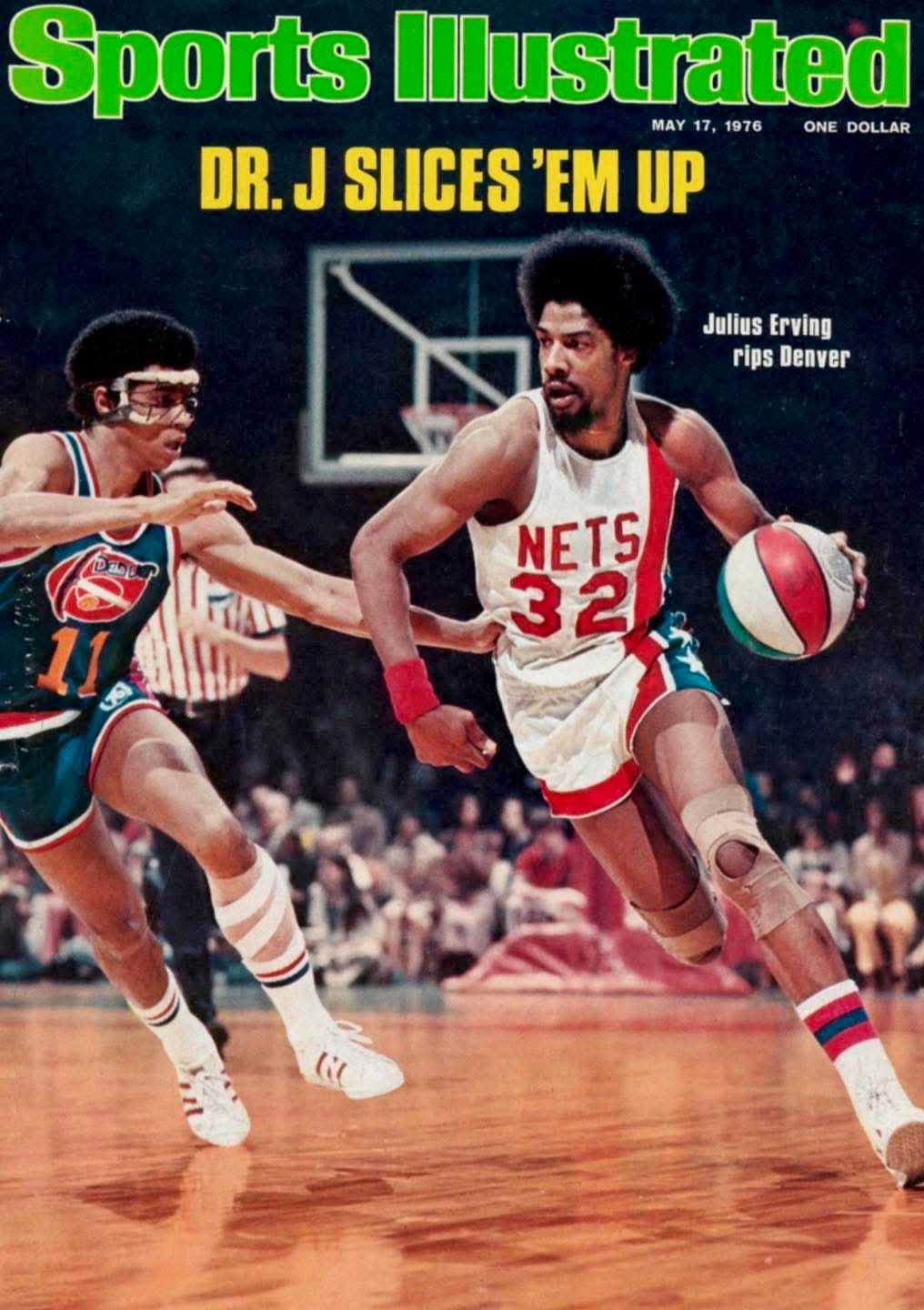
A Sportswriter Recognizes Dr. J as THE GOAT!
There’s more to this update. This morning in the May 18, 1976 New York Daily News, sports columnist Larry Fox wrote this:
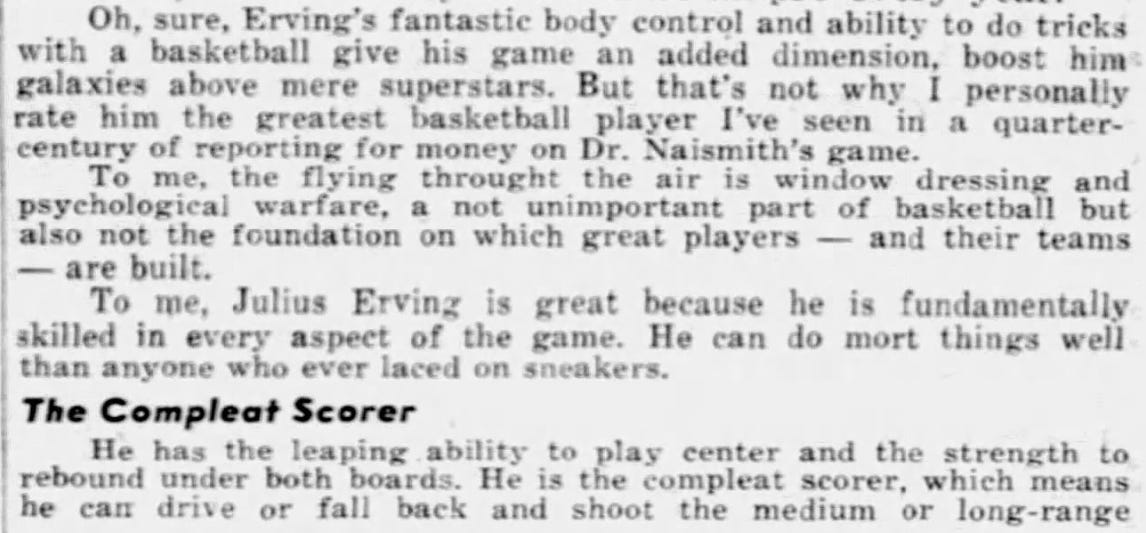
The key parts are these lines in which Larry Fox writes, “I personally rate him the greatest basketball player I’ve seen in a quarter-century of reporting for money on Dr. Naismith’s game… Julius Erving is great because he is fundamentally skilled in every aspect of the game. He can do more things well than anyone who ever laced on sneakers.”
Larry Fox affirms what I’ve been thinking for the past 50 years. Julius Erving in his prime, which was in the old ABA, was the best basketball player we’ve ever seen, and that includes MJ.
what a terrific trip onto pro basketball history/
I so miss the ABA …