

BACKGROUND
The Boys of Summer core group of position players, Snider, Campanella, Robinson, Reese, Hodges, and Furillo, remained in place for so many years that several great players in the Dodgers’ minor league system in the 1950s never got more than a cup of coffee in the majors.
A ballplayer by the name of Bert Hamric was one of those players who was a victim of the Dodgers’ logjam. Bert got his cup of coffee on the big league club. But it was so quick he didn’t even have time to add sugar.
Until this week, I had never heard of Bert Hamric. Just as I was putting the finishing touches on my book, THE 1955 BROOKLYN DODGERS - MY DAD’s TEAM, which comes out on Amazon on May 1st, I got a tip from a Dodgers’ Facebook group member, David Clouse, who is related by marriage to Bert Hamric. That tip led me to make one more quick virtual trip back to 1955, and ultimately to make one final update to the book before it’s published.
David told me that his wife’s uncle, Bert Hamric, played briefly on the 1955 Brooklyn Dodgers. I was almost incredulous because after spending every day last year following the 1955 Dodgers in the newspaper archives each morning, I didn’t recall coming across that name.
So I went to baseballreference.com and looked up which games he played in. Well lo and behold! 27-year-old Bert Hamric did play, albeit very briefly, on the 1955 Dodgers. He had the dubious distinction of appearing in 2 games, yet never taking the field. He never got to play his position - left field. It’s almost like the riddle of Moonlight Graham, from the movie Field of Dreams, who did play in the field but never had a plate appearance.
Then I took a look at the specific games Bert Hamric played in, and holy moly! He played in the conclusion of a game that comprises chapter 3 of my book! It’s a chapter titled, A CRAZY DAY AT EBBETS FIELD. We’ll get to that game in just a little bit. But first, you need to know more about Bert Hamric, because he’s someone every Dodgers fan should know a little bit about.
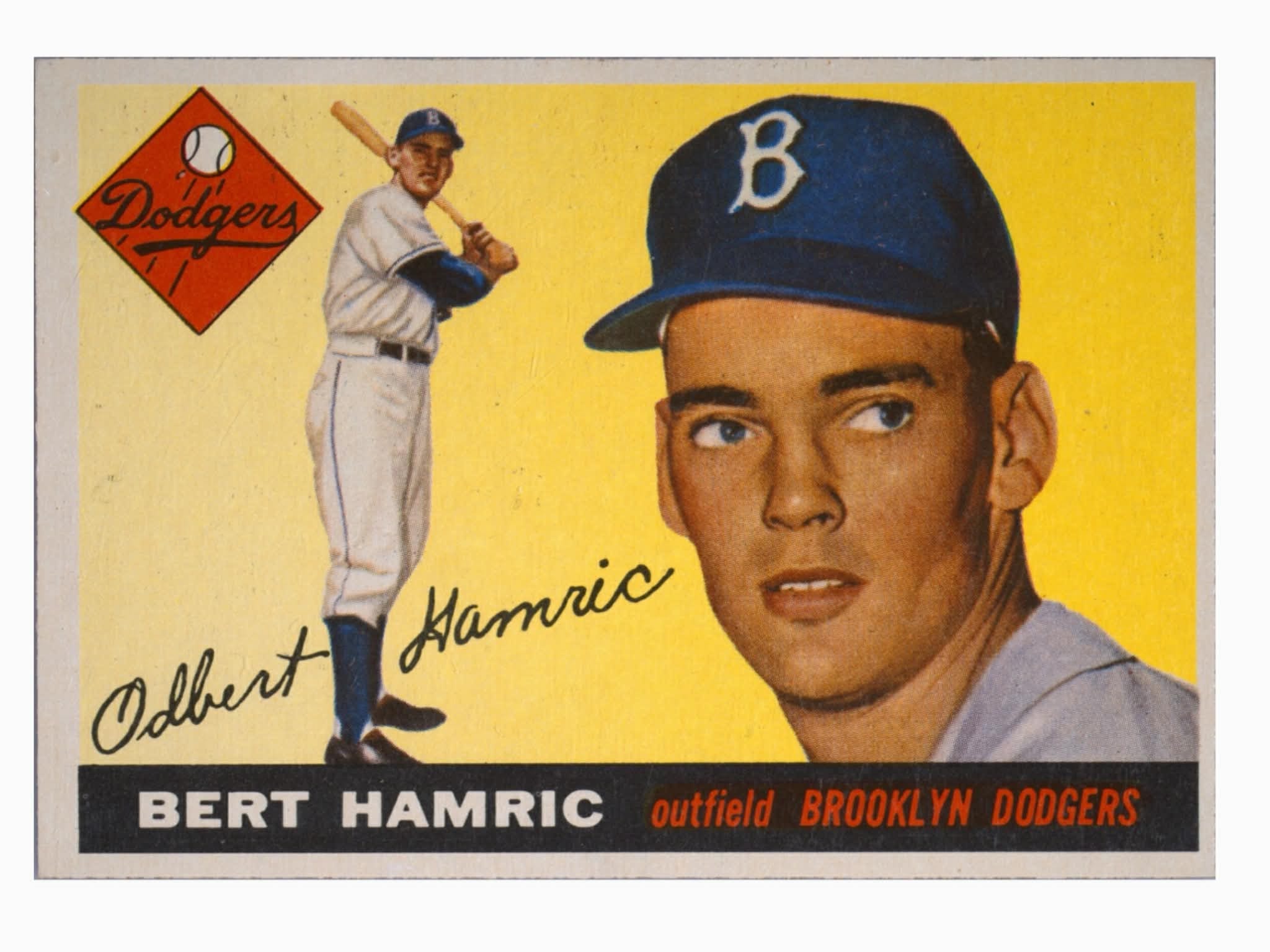
Bert Hamric was a heckuva ballplayer.
Prior to 1955, Hamric spent 6 years, and played 726 games, in the Dodgers’ minor league system. In that time, he had 1,000 hits and a batting average of precisely .300. He had hit as many as 18 homers in a season, and stole as many as 32 bases in a season.
The year before, in 1954, Hamric led the American Association batting .350, and was the 3rd leading vote-getter for the American Association All-Star team, just beating out Rocky Colavito.
And yet, due to the logjam, there had never been an opportunity for Bert Hamric to be called up to the Dodgers.
1955 was perhaps his best chance to make the team. The Dodgers, of course, had the Duke in center and the man they call Skoonj, Carl Furillo, in right. But the Dodgers were filling left field by committee. The most games any single player spent in left field in 1954 was just 69 by Sandy Amoros, who batted an uninspiring .274 with only 9 homers.
The left field job was open in spring training in 1955. And Bert Hamric was one of several players that was auditioning for the role.
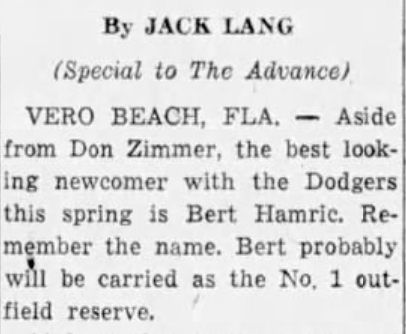
Bert got off to a great start. In his first spring training game on March 14th, he got an RBI single. In his next game, he hit a triple. Jack Lang of the Staten Island Advance was so enamored with Hamric that he implored readers to “remember the name” in this article he wrote on March 16th:
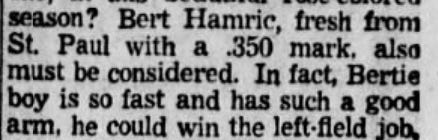
On the same day, Dan Parker in the Camden Courier Post wrote that Hamric could win the left field job:
But on March 20th, he dropped a fly ball hit by Mickey Mantle.
Despite the error on March 23rd, the New York Daily News reported that Dodgers’ manager Walter Alston was impressed by Hamric:

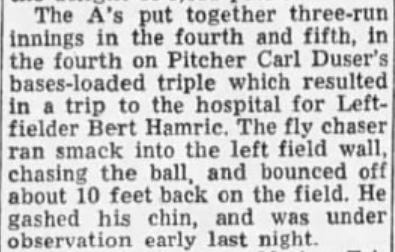
But on that same day, Hamric suffered a severe setback when he ran into an outfield wall chasing a fly ball, as reported by Dick Taylor of the Palm Beach Post:
The injuries put him out for about a week.
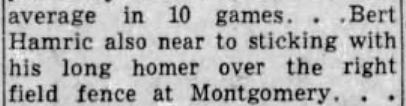
When Bert came back, he hit a homer in a game in Montgomery, Alabama, as the Dodgers started barnstorming north on their way to Brooklyn. Jack Lang thought Hamric had a great chance to make the team. He reported in the April 2nd Staten Island Advance, “Bert Hamric also near to sticking.”
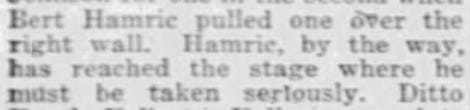
On the same day, the legendary Dick Young, writing in the New York Daily News, also indicated Hamric was close to making the Dodgers roster. Young wrote, “he must be taken seriously.”
BERT AS THE NEWEST BOY OF SUMMER
On April 4th, the Dodgers were in Nashville to play the Milwaukee Braves. The Dodgers had all their familiar position players in the lineup except for one. Bert Hamric was starting in left field.
Take a look at this precious picture of the Dodgers on the right side of the page in The Nashville Tennessean paper on April 4, 1955:
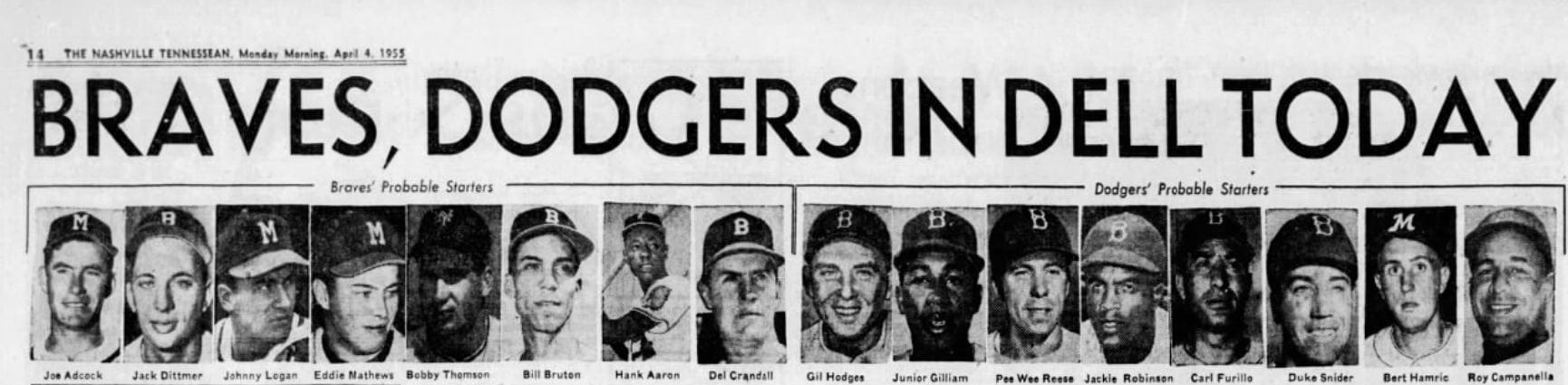
All the names except 1 roll of the tongue very easily to any Dodgers fan, 5 of them are in the Hall of Fame, 7 of the 8 played in at least 1,200 games for the Dodgers. The lone exception was Bert Hamric, pictured 2nd from the right, nestled in between Duke Snider and 3-time MVP Roy Campanella.
HAMRIC MAKES THE 28 MAN ROSTER
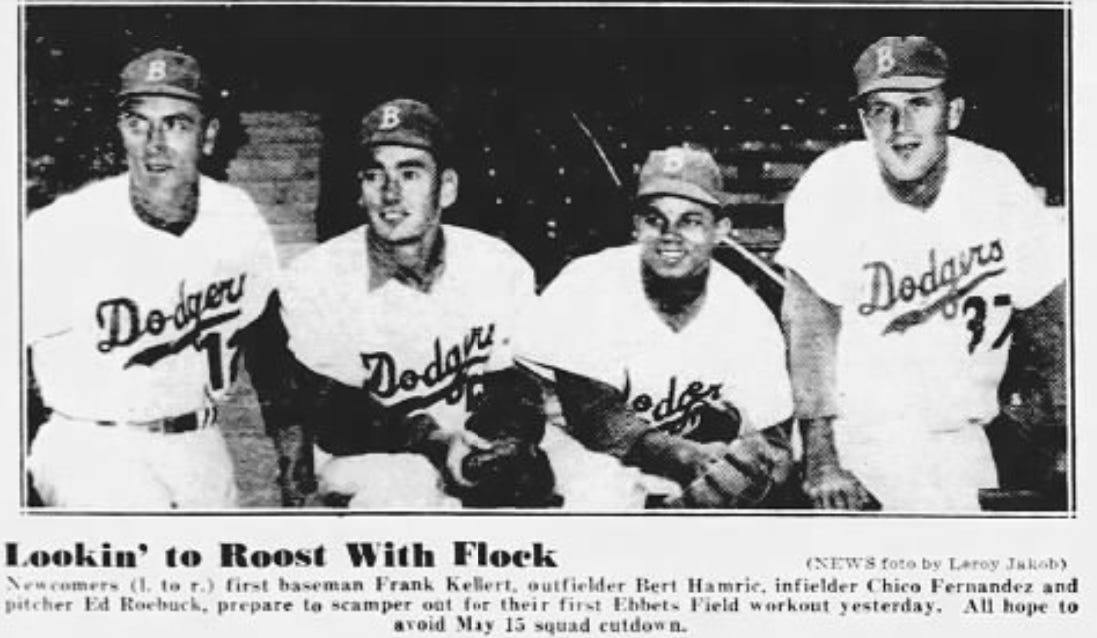
Bert Hamric did make the 28 man roster that big league clubs were allowed to keep at the beginning of the season.
Here you can see Hamric in the April 9th New York Daily News pictured with 3 other “newcomers” to the Brooklyn Dodgers:
But when the season began on April 13th, Sandy Amoros was the starter in left field. Amoros with 2 years of experience in the majors, and nearly 200 games under his belt, was the safe choice for Walter Alston. And the Dodgers won the game.
Amoros started the next game, and the Dodgers won again.
Amoros kept starting, and the Dodgers kept winning.
The Dodgers won their first 10 games - a new major league record.
And when they finally lost a game, Amoros went 4 for 5 to raise his batting average to .326. In the next game, Amoros went 2 for 4 and increased his average further to .348.
There was just no opportunity for Bert Hamric to get off the bench.
No opportunity until game 13 on April 24th. And that’s the game I wrote about in chapter 3 of THE 1955 BROOKLYN DODGERS - MY DAD’s TEAM.
I just had to go back in time again, and re-visit this one game and experience Bert Hamric’s first opportunity to play in a major league game.
Now, join me back in 1955.
EBBETS FIELD - April 25, 1955
Yesterday, the Dodgers, who have started the season 11 - 1, played one of the craziest games that ever took place in Ebbets Field. They played the defending World Series champion Giants on a Sunday afternoon in which the temperature never got higher than 49 degrees.
In the top of the 9th inning, the Dodgers were leading the Giants 5 - 3 with one out and nobody on. Whitey Lockman hit a comebacker to the mound that pitcher Billy Loes bobbled. Lockman reached 1st base safely. A moment later, Al Dark homered to tie the game.
The game went into extra innings with the two teams knotted at 5. In the top of the 10th, Willie Mays led off with a single, and that opened the floodgates for the Giants. They scored 6 times to put the game seemingly out of reach at 11 - 5.
But these Dodgers can hit. And when Roy Campanella singled with 2 outs, he drove in Duke Snider with the Dodgers’ 10th run of the game. The Dodgers had snapped back to make the score 11 - 10.
However, the Dodgers still needed a run to tie and 2 runs to win. And they were down to their last out.
Sandy Amoros was on 2nd base representing the potential tying run. Campy was on 1st base with the potential the winning run, and Carl Furillo, who had hit his league leading 6th home run earlier in the game, was coming up to bat.
Giants’ manager Leo Durocher decided to bring in Ruben Gomez to pitch to the The Reading Rifle, as Furillo is also known.
When Gomez came to the mound, he was the 7th Giants’ pitcher of the game, setting a new Giants’ record for most pitchers used in a game.
While Gomez warmed up, Dodgers’ manager Walter Alston brought in a speedster to run for the slow-footed Campanella at 1st base. This gave the Dodgers a chance to win the game should the hot-hitting Furillo drill an extra base hit.
That speedster was 27-year-old Bert Hamric. And when he took Roy Campanella’s place on the 1st base bag, it was the 1st time Bert had ever been in a major league baseball game after 726 contests in the Dodgers’ system in the minors.
Now Bert Hamric suddenly had the opportunity to score the winning run.
My God, what must have been going through Bert Hamric’s mind. He had to know that the crowd of over 20,000 fans were set to go wild if he should reach home plate. It would be one of the greatest comebacks ever, and to do it against the World Series champs and cross-town rivals would make it even more special.
Furillo stepped in against Gomez and got wood on the 1st pitch. But it was a pop-up behind 3rd base. The ball was caught by the Giants’ Hank Thompson. The game was over. Hamric would not receive a hero’s welcome at home. Final score Giants 11 - Dodgers 10.
POSTSCRIPT
Bert Hamric didn’t get the fairy tale finish to his first appearance.
Neither did he get much of a 2nd chance.
4 days later, Bert Hamric pinch hit for Carl Erskine to lead off the bottom of the 6th inning in a game against the Cubs. He struck out. There was no shame in that. Up to that point the Dodgers had only 1 hit off Cubs’ pitcher Bob Rush. That 1 hit was by Sandy Amoros.
And that was it for Bert Hamric.
He never even got a chance to play in left field.
Walter Alston never gave him the fair look he deserved.
The next day, the Dodgers shipped Bert Hamric and 2 other players down to the minors, as the team began the painful process of paring down to 25 players.
Below is the story by Dick Young in the April 28, 1955, New York Daily News. Young noted about these 3 players, “They are victims of circumstance - the circumstance being the Brooks are just too good at the moment.”
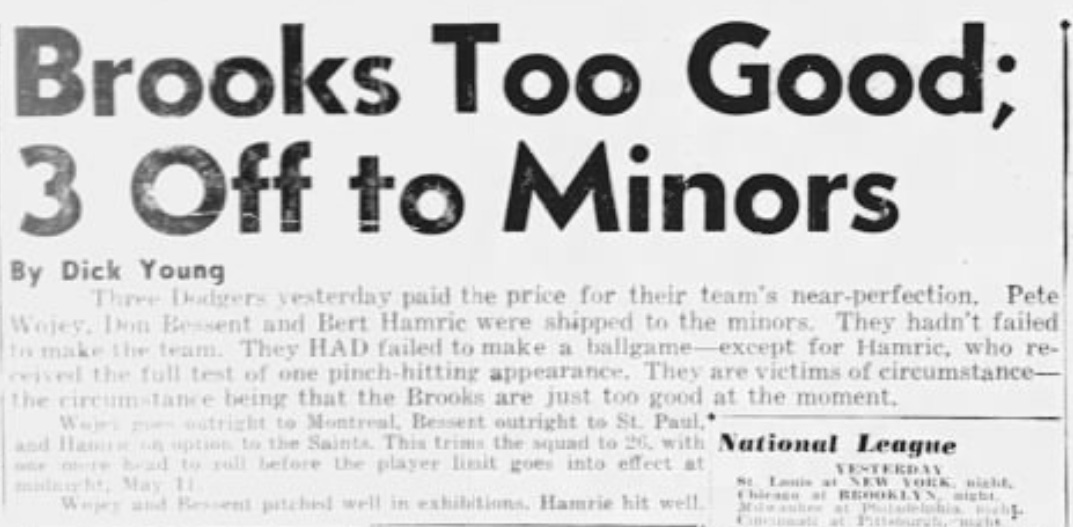
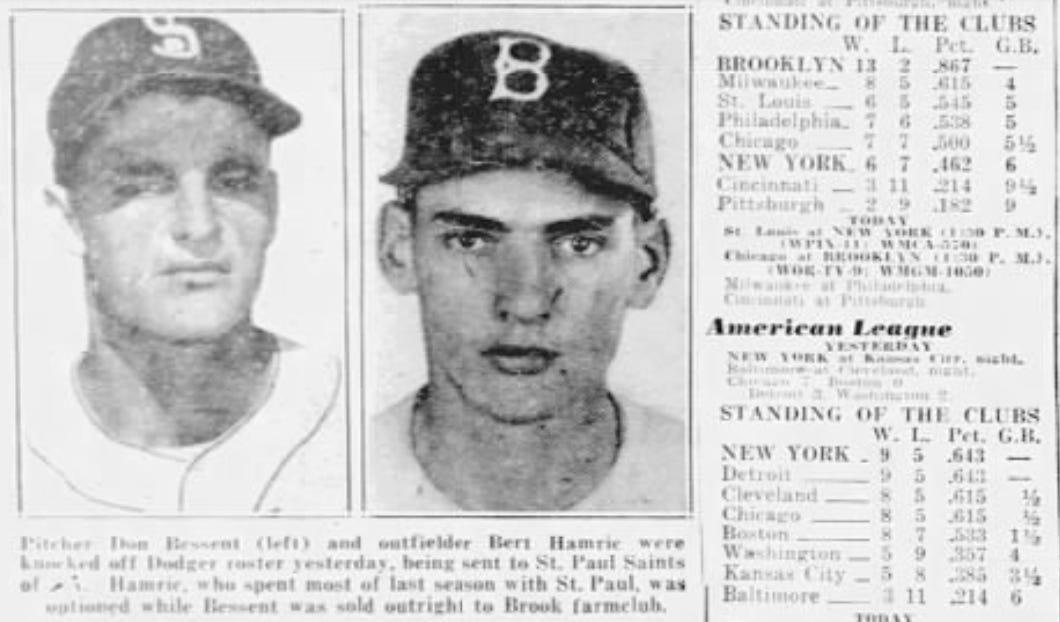
By the end of April, Hamric was back in AAA, where he batted .290 in 1955, and .299 in 1956. He never again had an opportunity to play for the Dodgers in the big leagues.
Bert Hamric played nearly 1,000 games as an outfielder in the Dodgers’ minor league system in his career, and he never even got a single chance to play in the outfield in Ebbets.
Hamric never had a chance after Sandy Amoros’s fast start in 1955. Amoros was batting .341 as late as June 3rd.
And Amoros was even better defensively. While his batting average dropped in the 2nd half of the season, his fielding remained consistent. Amoros made only 6 errors all season. And he led the National League in assists by a left fielder in 1955.
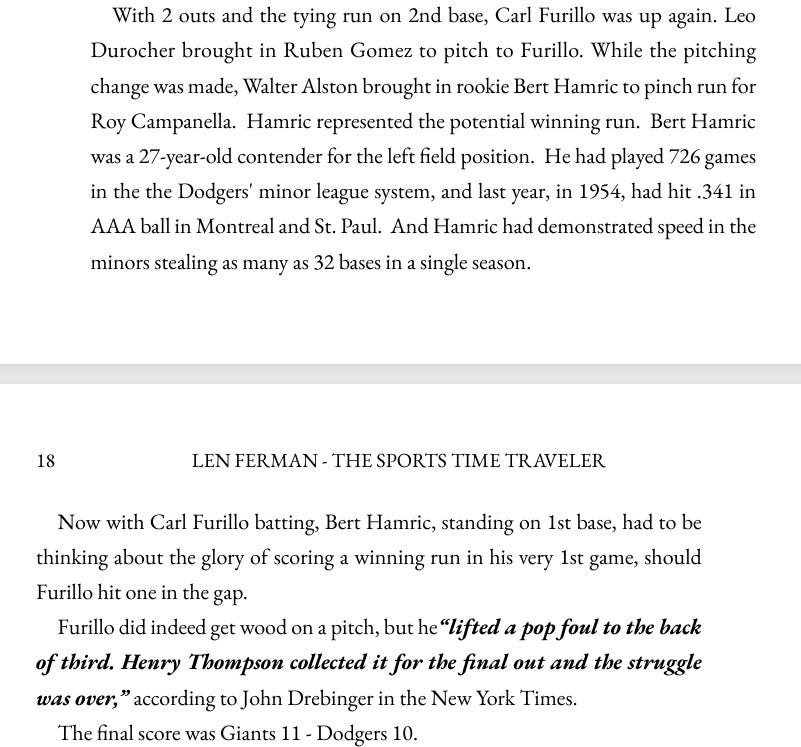
After learning about Bert Hamric, I felt compelled to celebrate him. So I made one final update to my book, THE 1955 BROOKLYN DODGERS - MY DAD’s TEAM, before it launches on May 1st. I wanted to include Bert’s name because he deserves to be mentioned.
Below is the portion of the book that I updated to include Bert Hamric. We pick up the action in the bottom of the 10th inning in that crazy April 24, 1955 game:
SECOND POSTSCRIPT
After I posted a short version of this story earlier this week, I received a message from a member of the Brooklyn Dodgers Historical Society Facebook group.
Lenny Levine actually saw Bert Hamric play in 1955!
Here is what Mr. Levine wrote:
“As a teenage Dodger fan in 1955, I read all the articles about his success during spring training and couldn't wait to see him. And I did see him, once. He pinch hit during the Dodger-Yankee exhibition game at Ebbets Field that they played every year just before opening day, which I always attended. He made out, although I don't recall how… But Bert Hamric has always stuck with me, for some reason.”
Bert Hamric was perhaps the greatest minor league player in Dodgers history who never took the field for the Dodgers.
So here’s to Bert Hamric, who is forgotten by most, but will soon have his name remembered in THE 1955 BROOKLYN DODGERS - MY DAD’s TEAM.
The book will be available on Amazon in paperback and Kindle versions on May 1st.
He pitched in 12 games, 5 starts and went 2-2. 41.2 innings pitched. 28 walks. ERA 3.02. WAR 0.9.
1. The Dodgers had such a backlog that they lost their "bonus baby" Roberto Clemente, whom they tried to hide in Montreal, to the Pirates after the 1954 season.
2. Furillo's nickname, The Skoonj, is also the name of the play he was known for. Because of the short right field wall and the very tall scoreboard, he played a very short right field and would sometimes throw a batter out at first after a ball hit sharply to right. That's a Skoonj.
3. A "bonus baby" who made the 1955 team was Sandy Koufax, signed for a $14,000 bonus, forcing the Dodgers to keep him on the team to protect him from being claimed by another team. I saw him pitch at Ebbets Field in 1956 and 1957.