

Berkeley, California - November 23, 1975
The Sports Time Traveler is here in Northern California, 50 years ago, because this is where Cincinnati Reds’ 2nd baseman Joe Morgan maintains his off season home, not far from where he grew up in Oakland.
Earlier this week Morgan was at his home when he received one of the biggest phone calls of his life. It was to inform him that he had not only won the National League’s MVP award, but had received a record margin in the voting.
Joe Morgan, the littlest player in the entire National League at 5’7”, had just won the MVP by the biggest margin ever.
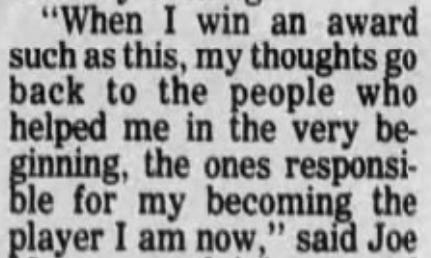
Morgan was appreciative of the award but had this to say to Charlie Zeno of the Contra Costa Times, a newspaper near Berkeley:
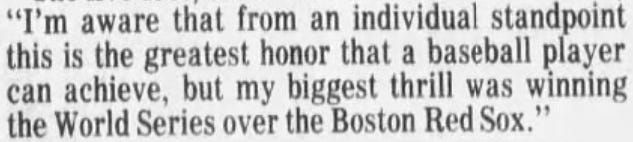
Morgan spoke like the consummate MVP, who thinks of the team goals first. And there can be little doubt that Morgan truly was thrilled by the Reds’ World Series victory last month. After 13 years in the majors, at age 32, Joe Morgan was finally a World Series Champion.
And this Reds’ team, which had aptly earned the moniker, “The Big Red Machine,” and has the best winning percentage in baseball in this decade, had finally won a World Series after several heart-breaking near misses earlier in the decade.
In fitting fashion, it was Joe Morgan who drove in the winning run in the 9th inning of game 7 of the World Series last month against the Red Sox.
You can watch Morgan’s World Series winning hit here:
Morgan was quick to share with Charlie Zeno this week how the thrill of the World Series was so much greater than winning the MVP:
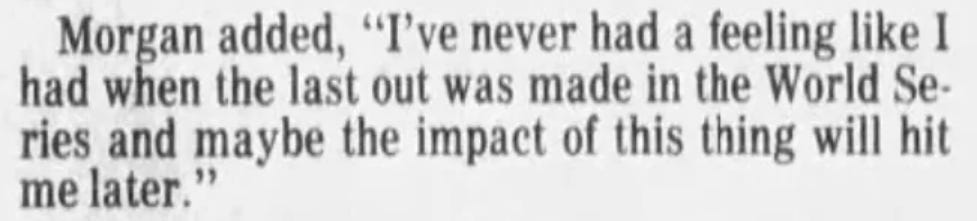
One thing that added to the thrill for Morgan was how hard fought this World Series was. After losing game 1, when the Red Sox’s Luis Tiant thew a 5-hit shutout (Morgan had 2 of the Reds’ 5 hits), the Reds had come back to take a 3 games to 2 lead.
Then, game 6 yielded one of the most dramatic moments in World Series history, when the Red Sox’s Carlton Fisk hit his famous walk-off homer in the 12th inning of that tied the series at 3 games apiece and set up the decisive game 7.
Any recalling of the 1975 World Series can not be complete without taking a few seconds to watch Fisk’s classic arm motions, as he willed the high fly ball he hit down the left field line to stay fair. You can see that at the 20 second mark on the tape below:
Fisk’s homer set up game 7 which went to the 9th inning tied until Morgan’s hit proved to be the World Series winner.
But World Series heroics are not part of the equation for being voted MVP. And Morgan won the MVP this year by the largest vote margin ever.
Why Did Morgan Win the MVP By the Largest Vote Margin Ever?
One reason Morgan won the MVP is that he was clearly the driver of the Big Red Machine this year, in what was easily the franchise’s greatest season. The Reds finished with a record of 108 - 54 and became one of a few teams to ever finish 20+ games ahead of the 2nd place team, which in this case was last year’s National League Champion Dodgers.
NOTE from The Sports Time Traveler
I interrupt this article to inform you that the 108 wins remains the most wins by a Reds’ team in franchise history.
Now back to 1975.
But a larger reason why Morgan captured the MVP was summed up by Joe himself, in his conversation with Zeno:
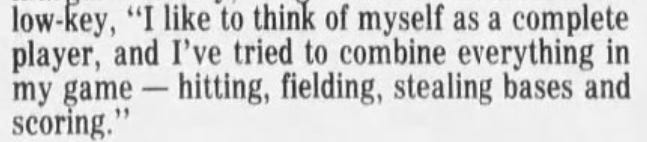
Indeed, Joe Morgan is perhaps most complete player in history up to this time. No one has ever had a season quite like what Joe put together in 1975.
At first glance his key stats don’t seem to be anything special:
HR RBIs Batting Average
17 94 .327
Those numbers are nice, but they hardly look like a typical MVP stat line.
In those key stats, Greg Luzinski of the Phillies, who was the distant runner up in the MVP voting, had the prototypical gaudy MVP-ish stat line:
HR RBIs Batting Average
34 120 .300
But dig a little deeper and you will see some eye popping numbers for Morgan that set him apart from nearly every other MVP in history:
Gold Glove award for 2nd basemen
.986 Fielding % (1st in NL. 2nd was Marty Perez at .985)
132 Walks (1st in NL. 2nd was Jim Wynn at 110)
.466 OBP - On Base Percentage (1st in NL. 2nd was Jim Wynn at .403)
2.54 Walks to Strikeouts ratio (1st in NL. 2nd was Bobby Murcer at 2.02)
.974 OPS - On Base Plus Slugging Percentage (1st in NL. 2nd was Greg Luzinski at .934)
67 Steals (2nd in NL)
13% Caught stealing ratio (1st in NL for anyone with 12 or more attempts)
No one up to this time has ever amassed a set of statistics that rivals Joe Morgan’s 1975 season.
Some of the above statistics, such as OBP and OPS are not ones that are well known and are NEVER reported on in newspapers at this time.
But one sportswriter in 1975 did put together an astonishing new statistic in analyzing Joe Morgan’s season. It’s a statistic that is easy to grasp and is one I wish would be utilized back in 2025.
Ron Coons, of the Louisville Courier-Journal, wrote an incredible story on August 3, 1975, in which he introduced the concept of “Total Base Value.” Coons developed this intuitive and easy-to-grasp statistic to demonstrate Joe Morgan’s superiority over all major league players.
Here’s how Coons calculated Total Base Value.
First, develop a “total base” number which Coons did by adding the following:
4 for each home run
3 for each triple
2 for each double
1 for each single
1 for each walk and hit-by-pitch
1 for each stolen base
Next, divide the total base number by the number of plate appearances.
Coons displayed how major league players fared in Total Base Value as of August 3, 1975. Morgan was the leader by an enormous margin when you consider that the players ranked #2 to #6 were all tightly bunched.
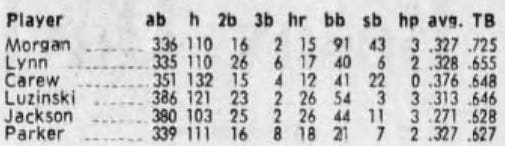
Coons then went on to show where Morgan’s season ranks in history up to 1975.
The best in history was Babe Ruth with a TB of .908 in 1920.
But take a look at the top TB ratios since 1938:
.773 Mickey Mantle, 1956
.770 Mickey Mantle, 1957
.751 Hank Greenberg, 1938
.748 Stan Musial, 1948
.738 Willie Mays, 1955
.727 Willie Mays, 1957
.727 Ralph Kiner, 1949
.725 Joe Morgan, 1975
Morgan compares favorably to anyone since 1938, and he exceeds everyone since Mantle and Mays in 1957.
No one in at least 18 years has had a season batting like Joe Morgan.
And that doesn’t take into account his gold glove fielding at the critical 2nd base position. Mantle, Mays and all the others ahead of Morgan in the above table were outfielders, and while Mantle and Mays were two of the best center fielders ever, it’s just not as essential a fielding position as 2nd base. And Joe Morgan was the best fielding 2nd baseman in 1975, winning the Gold Glove and leading the league in fielding percentage.
And then there is one more mind boggling statistic. Joe Morgan, only grounded into 3 double plays all season. Nobody in baseball who had at least 500 plate appearances grounded into less double plays than Joe Morgan in 1975.
There is yet another intangible factor that made Morgan most valuable this year. This one was pointed out by Ron Coons in his same August 3rd article. Noting both Morgan’s sensational on base percentage and his threat of stealing, Coons offered this insight:
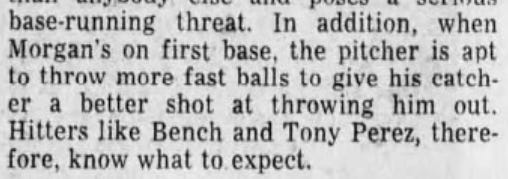
Johnny Bench, most often the clean up hitter, hit 28 homers and drove in 110 runs in 1975.
Tony Perez, most often the number 5 hitter, hit 20 homers and drove home 109 runs.
Both men benefitted from hitting behind Joe Morgan.
Morgan on the basepaths also provided an extra spark for the Reds all season. It was most evident in game 1 of the NLCS against the Pirates. Down 2 - 1 in the 3rd inning, Morgan led off with a walk. Bob Hertzel of the Cincinnati Enquirer described what Morgan did next and the impact it had on the game:
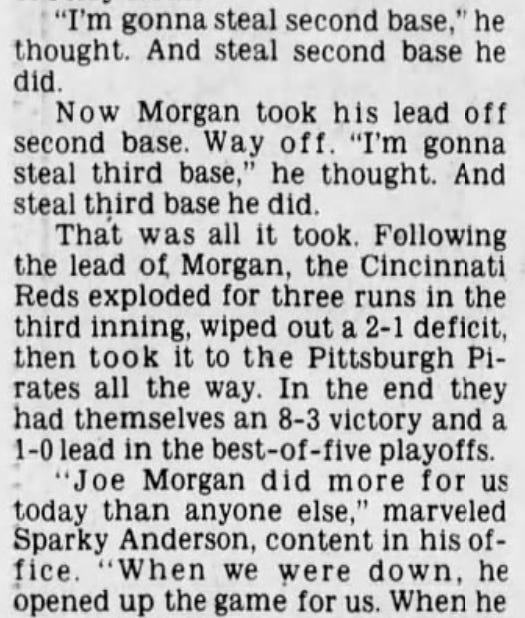
The Reds went on to win game 1.
Another hallmark of a great MVP is that he makes his teammates better. And Morgan certainly qualified in that category as well this year. Hertzel wrote an article on October 6th in which he described the catalyst behind the Reds’ 7 steals in game 2 of the NLCS that led to their 6 - 1 plundering of the Pirates to take a 2 games to none lead.
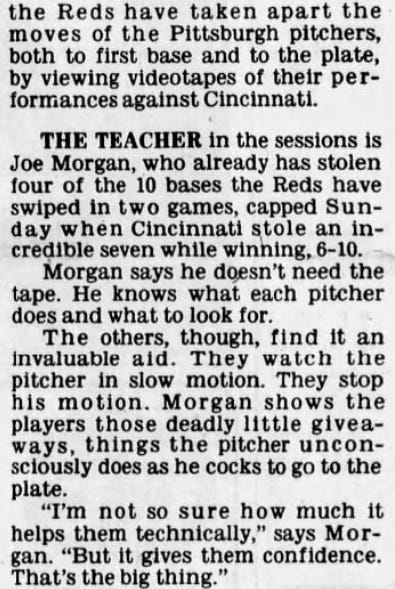
So Joe Morgan was actually teaching his teammates the art of the steal.
It’s no surprise then that the Reds led the league in steals and caught stealing %.
Morgan the Compassionate MVP
No story about Joe Morgan this week however, was as touching however as the one written by UPI sports editor Milton Richman that appeared in the Berkeley Gazette and papers around the country.
After the MVP announcement, Morgan had been receiving non-stop phone calls. Richman reported:
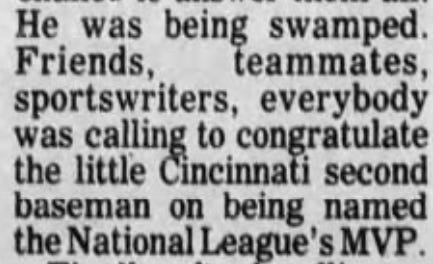
But Morgan took the time to make a special outbound call. Morgan had heard that his former coach, Nellie Fox, from his early days with the Houston Astros, was being treated for cancer. He was determined to talk to Fox.
Morgan told Richman:
Morgan shared with Richman some of the valuable advice Fox had shared with him early in his career:
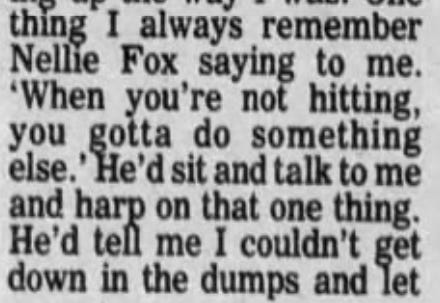
It was Fox who had motivated Morgan to become the complete player. And it was because of him being a complete player that Morgan won the MVP.
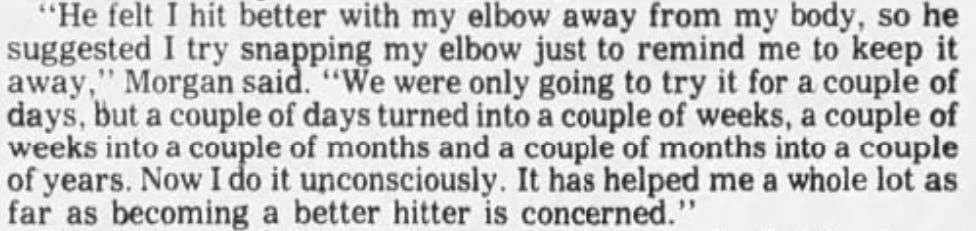
And it was also Fox who helped Morgan develop his signature move in the batter’s box. If you watch the World Series game 7 winning hit again (see YouTube video above), you can’t help but notice the way Morgan flaps his arm prior to the pitch coming in. Fox had coached Morgan on finding a way to keep his elbow away from his body when he was hitting. Morgan described this to Richman:
There’s no record of what Morgan said to Fox on the phone call, but it was the act of making that call that counted. Joe Morgan is not just the most valuable player, he is the most valuable person in baseball this year.
The Sports Time Traveler will continue following baseball next year in 1976.