
Last week I posted part 1 of my incredible virtual time travel trip 100 years into the past to experience the 1926 World Series.
You can read that story, which covers games 1 - 6, online at: www.sportstimetraveler.com
Email subscribers can also read today’s story at the same link to ensure you see all content, some of which may be truncated in the email version.
Now, I’m thrilled to share the epic story of game 7.
YANKEE STADIUM - October 11, 1926
Yesterday, on the morning of game 7, it was gray and dreary. And it was cold. Game time temperature climbed to just 47 degrees. In addition, there was a threat of rain.
Fans also had the option to stay home and listen to the radio broadcast.
All this combined to produce yet another record, this one for the smallest World Series crowd ever in Yankee Stadium. The official attendance was under 40,000.
The New York Times reported, “There were wide open spaces in the upper tiers of the grandstand to say nothing of the outfield bleachers.”
Those who braved the elements were rewarded amply with a game 7 as entertaining as any in baseball history.
The Pitchers
Jesse Haines for the Cardinals and Waite Hoyt for the Yankees were the manager’s selections for this winner takes all contest.
Haines was making his 2nd appearance in the series. He had pitched the only shutout of the series back in game 3 in St. Louis.
Hoyt had been the game 4 winner, but even though he had allowed the Cardinals only 2 earned runs, he had not looked stellar in giving up 14 hits.
Play Ball!
Rogers Hornsby got the 1st hit of the game when he singled off Hoyt in the top of the 1st. But Hoyt didn’t let Hornsby get any further.
In the bottom of the 1st, Babe Ruth stepped into the batters box with 2 down. On the radio broadcast, Graham McNamee told listeners, “The crowd is giving Babe Ruth a tremendous volley of cheers to encourage him as he comes up to the plate.
After Haines’ 1st pitch to the Babe was a ball, McNamee reported, “The crowd evidently thinks Haines is going to pass him and is booing at the top of their voices.”
Haines did pitch around Ruth, and so the Sultan of Swat walked for the 5th time in his last 11 plate appearances since he hit his 3rd home run in game 4. But walking Ruth did help the Cardinals get out of the 1st inning unscathed.
Cards 0 - Yankees 0 - end of 1st inning
In the top of the 2nd, Hoyt got the first 2 Cardinals out. Then Bob O’Farrell hit a tremendous shot to deep right-center. James Harrison described the action as Babe Ruth gave chase, “he sprinted at top speed back almost to the running track and enfolded O’Farrell’s terrific line drive in his glove, thrust up and out as the Babe left his feet ever so slightly. For this he got another tornado of cheers from the multitude.”
Harrison called it, “the most sensational play of the closing game.”
Cards 0 - Yankees 0 - end of 2nd inning
In the bottom of the 3rd, Babe Ruth came to the plate with 2 outs. On the radio, McNamee described the Bambino prior to the 1st pitch from Haines: “Again the crowd is cheering Babe Ruth as he comes to the plate. He digs his right foot into the ditch right near the plate. His body pivots at the waist as he swings, and he gets tremendous leverage. Before he hits the ball, he gets a half swing of the body. No wonder the ball travels he hits.”
We next pick up McNamee’s call with the count at 1 and 1 to Ruth: “Here it is! A long drive into the right field, and - a home run! There you are, a long drive into the right field bleachers making the score 1 to 0 in favor of the Yankees, amidst a terrific noise. Babe comes in after a slow jogging trip around the circuit, bows and takes his hat off to the crowd.”
James R. Harrison wrote about Ruth’s homer, “The ball passed directly over the words ‘World’s Champions’ in the razor ad. ‘A happy omen,’ yelled the Yankee rooters.”
With Hoyt having pitched 3 shutout innings so far, there was every possibility that Babe Ruth had just driven in the winning run for the World Series title.
Yankees 1 - Cardinals 0 - end of 3rd inning
Hoyt opened the top of the 4th by getting Hornsby to ground out. Then he let up a single. Now with 1 out and a man on 1st, Hoyt got Les Bell to hit a perfect double play ball to shortstop Mark Koenig to make it a short trip on the mound in the 4th.
Here’s how Harrison described the play, “The kid shortstop played the ball to one side, and in his eagerness to kill two birds with one stone fumbled the roller.”
So, there was no double play. Everyone was safe. The Cardinals had runners on 1st and 2nd and still just 1 out.
The next batter, Chick Hafey, hit a little Texas Leaguer to shallow left that dropped in between Koenig the shortstop and Meusel the left fielder. That loaded the bases.
Now with bases full of Cardinals and still just 1 out, Bob O’Farrell stepped in for the Cardinals.
Let’s pick up the radio call from McNamee: “A high fly to Meusel in left - and - Meusel drops the ball. Oh, Meusel - he feels mighty bad about it.”
Meusel’s muff allowed an unearned run to tie the game, and then 2 more unearned runs scored when the next batter, Tommy Thevenow, hit a single to right field. Suddenly the Cardinals were up 3 - 1.
The score remained the same until the bottom of the 6th, when Hoyt was lifted for a pinch hitter and the Yankees scored to pull within a run at 3 - 2.
Waite Hoyt had pitched admirably for a game 7. In 6 innings of work he had allowed no earned runs and just 3 base runners, all on singles, not including what happened after the folly in the 4th.
Now Herb Pennock took the mound for the Yankees. He had been victorious starting pitcher in both games 1 and 5. Over 19 innings of work he had allowed just 3 earned runs. Pennock made short work of the Redbirds in the 7th.
Cards 3 - Yankees 2 - 7th inning stretch
The Yankees were still a run behind, and in the bottom of the 7th, they had a big opportunity with the top of the order coming up.
Earle Combs got things going with a single, it was the 8th Yankees hit off Haines.
Mark Koenig bunted Combs over to 2nd. That brought Babe Ruth to the plate.
Now Rogers Hornsby was not taking any chances with the Babe. He called for a conference at the mound and he instructed Haines to give the Babe a base on balls.
The Yankees had the tying run at 2nd and the go ahead run at 1st base and 1 out for Bob Meusel. He hit a shot to 3rd base. The throw to 2nd got Ruth for the 2nd out. But Combs went to 3rd base, and so the Yankees now had the tying run 90 feet from the plate, and the go ahead run on 1st base with Meusel.
The next batter was Lou Gehrig. And he too was given a pass.
Poosh ‘Em Up Tony
The bases were loaded, 2 outs and rookie Tony Lazzeri was due up. The 22-year-old had a remarkable rookie season driving in 117 runs. Now he had the opportunity to be a World Series hero. He could put the Yankees in front with an extra base hit.
Lazzeri had plenty of power. Playing last year for Salt Lake City in the Pacific Coast League he had hit 60 home runs.
That’s right 60!
In doing so, he became the first professional baseball player to ever hit 60 homers in a season.
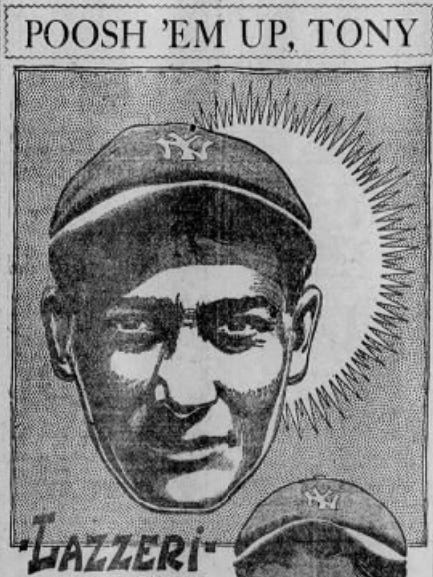
McNamee on the radio said the crowd is shouting, “Poosh-em-up-Tony, Poosh-em-up-Tony.” This unusual cry from the crowd had become a standard yell for Lazzeri in the Pacific Coast League and the Yankees’ fans had gladly continued its use.
Two weeks earlier the Passaic Daily Herald in northern New Jersey had published a picture of Lazzeri with a banner above the picture quoting the crowd call used as his nickname.
So well known was the crowd call that even the Los Angeles Herald Examiner published this caricature of Lazzeri in the pre-World Series coverage featured in their October 1st edition.
The Cardinals Call a Conference
Before Haines could throw a pitch to Lazzeri, Rogers Hornsby called a conference at the mound. McNamee told the radio audience, “The umpire is going to get on the confab, too. The whole infield is gathered around Haines.”
The Cardinals’ plotting continued. McNamee spoke into the mic, “It is a long, long wait... A new pitcher is being called in. Alexander, Alexander is being called in.”
Incredulous at this move by Rogers Hornsby, McNamee continued, “Alex has already pitched two full games, winning the second game yesterday afternoon.”
A Bold Move
What a bold move this was, reminiscent of the 1924 World Series when Walter Johnson came to the mound late in game 7. But in that case, Johnson had a day of rest. And Johnson wasn’t facing the bases loaded.
“Old Pete,” as they called Alexander, was 4 months shy of his 40th birthday, and was coming into this game, in the most critical situation, bases loaded, 2 outs, and a slugger at the plate, with 0 days rest, having pitched 9 innings the prior day.
W.O. McGeehan, who was covering the game for the Pittsburgh Post-Gazette described the scene when the call went out for Grover Cleveland Alexander, “Mr. Alexander muttered something that seemed like, ‘What? Again?’ ... Mr. Alexander shambled forth with much deliberation… Mr. Alexander took his time about arriving at the box.”
Then McGeehan focused on Tony Lazzeri, who hails from San Francisco, and was the batter Alexander would face with the bases loaded and 2 outs here in the bottom of the 7th with the Cardinals clinging to a 3 - 2 lead in Yankee Stadium, “His fellow tribesmen, the rock rollers of Telegraph Hill, were sitting besides their radios listening for the blow of the bat of Signor Antonio Lazzeri.”
McGeehan continued his description of this biggest moment of the World Series so far, “As Mr. Alexander neared the box he spat with much unconcern and looked at Signor Lazzeri somewhat disdainfully… It seemed as though some of Signor Lazzeri’s courage had started to ooze the moment Mr. Alexander started his deliberate and unconcerned walk from the dugout to the box.”
Alexander Takes the Mound
Grover Cleveland Alexander was walking to the mound. The great player whose career had looked caput, was now Hornsby’s choice to throw the most important pitches of this World Series.
So compelling was this heart-warming story that the Yankee Stadium crowd began to cheer for him.
Grantland Rice described this phenomenon that occurred during Alexander’s entrance into the game 7 with the bases loaded with in the last of the 7th inning, noting there was an, “emotional salve of thousands who had turned from cheering a Yankee rally to pay tribute to an old arm that was on its way to cut the home club down.”
The Radio Call
Here was the radio call by McNamee as the count was 1 and 1 and Grover Cleveland Alexander was pitching in perhaps the most consequential moments of his career, “The next ball, a foul, a long shot into left field stands for the second strike - two strikes, one ball. And - he struck him out!” Alexander the Great comes in and strikes out Tony Lazzeri, retiring the side. The entire Cardinal team has rushed over to Alexander, petting him and patting him on the back, and are simply wild over him.”
What a great moment for Old Pete.
Richard Vidmer in the New York Times described the scene after Alexander struck out Lazzeri with the bases loaded to end the 7th inning, “Grover Cleveland Alexander tossed his glove aside, lumbered out of the box and the three Yankee runners walked dejectedly to their positions in the field. He has faced the fire and come through. The cunning old brain and the accurate arm of the veteran had conquered the young, ambitious batter.”
But there were still 2 innings to play!
In the top of the 8th, Hornsby led off with a single, and he reached 3rd with 2 outs, but was stranded there by Pennock.
In the last of the 8th, Alexander was back on the mound and he made short work of the Yankees, retiring the bottom of the lineup in order.
McNamee at this point is amazed by Alexander’s performance as he has now set down the first 4 Yankee batters he has faced under enormous pressure, protecting a 1 run lead in game 7. He tells the radio audience, “Alex is pitching now as though he had not pitched for four or five days, as though he were a perfectly rested man.” And yet this man, nearing 40 years old, had pitched a complete game masterpiece just yesterday.
The Top of the 9th
In the top of the 9th, Pennock retired the Cardinals in order. Hornsby allowed Alexander to bat, indicating that he wanted Old Pete to stay in there and be the man to protect the lead in the bottom of the 9th.
Waite Hoyt and Herb Pennock had done their job spectacularly. The two Yankee Starters had combined to allow no earned runs to the Cardinals in 9 innings.
But due to the 4th inning blunders by Koenig and Meusel, which led to all 3 Cardinals unearned runs, the Yankees were down 3 - 2.
The Bottom of the 9th - Cards 3 - Yankees 2
And so the 1926 World Series came down to the bottom of the 9th inning in Yankee Stadium, with the Yankees needing a run to extend the game and 2 runs to win the World Series.
The Yankees had the top of the order up again as they had in the 7th. Earle Combs led off and grounded out.
Mark Koenig also grounded out.
Now the Yankees were down to their last out.
Grover Cleveland Alexander, nearly 40 years old, was one batter away from his 1st World Series championship in his career, a career that seemed over just 4 months earlier.
But that batter coming up was Babe Ruth.
The Classic Confrontation
How epic is this!
One of the greatest pitchers in history facing the most famous hitter in America with the World Series on the line.
It couldn’t be more dramatic.
It couldn’t be better scripted.
Old Pete, the pitcher, had already won 327 games in his career.
Babe, the batter, was already the career leader in home runs with 356. And Ruth was now also the record holder for most home runs in a single World Series with 4, including 1 in this game.
Grover Cleveland Alexander vs. Babe Ruth
The World Series was on the line. Cards ahead 3 - 2. Game 7, bottom of the 9th, 2 outs. Grover Cleveland Alexander is on the mound and the batter is Babe Ruth.
Is this really happening? It is.
We have to experience Graham McNamee describe it to the radio audience of about 20 million, the first time a radio audience across America ever heard the live call of such a dramatic moment in a World Series. “Babe Ruth is up. Rogers Hornsby is now talking to one of the greatest pitchers in baseball to decide what to do about Ruth. It seems that Hornsby wanted Alexander to pass Ruth and Alexander didn’t want to do it. Alexander seemed to hesitate to do what he was told.
Alexander threw the first pitch to Ruth for a strike.
It’s fascinating when the manager is the 2nd baseman and in constant ear shot of the pitcher.
On the radio, McNamee was trying to interpret the chatter on the infield.
We again pick up McNamee on the radio call, “That may not have been the conversation at all. Hornsby may have been telling him to pitch to Ruth.
Alexander throws the 2nd pitch to Ruth and it’s a little outside for a ball. The count is 1 and 1.
Now, McNamee calls the 3rd pitch, “Here it is coming up - a foul ball. Two strikes and one ball and the crowd howls with joy. So we give it to them for good sportsmanship. I say we will.
It seems as though the crowd in New York is actually pulling for Old Pete who now needs 1 strike to finish off the Yankees and win the World Series for St. Louis.
One Strike Away
The tension rises. McNamee sets the stage, “Here is what we came to see. There is danger of a home run, tying the score, and Alexander the Great is pitching to Babe Ruth.”
It’s a surreal fantasy moment, yet it’s actually happening.
The next 2 pitches are both balls. The count is full at 3 and 2.
Ben M. Hacock of the Bayonne Evening News was in the press box and wrote about the last 2 pitches in this great confrontation between Alexander and Ruth, “He was pitching to Ruth, but trying to cut the very edges of the corners after the righthander had two strikes on the Sultan of Swat.”
Now let’s return to McNamee as he calls the payoff pitch, “A ball just outside. Ruth is again walked for the fourth time today.”
And back to Hacock in the press box, “Long before Babe Ruth went to bat in the ninth, the press boys were discussing one point: ‘Will Alex pitch to the Babe?’ And he did for the first five balls he hurled. But it our firm conviction that with three on Ruth, Alex voluntarily allowed the Bambino to take his base.”
NOTE from The Sports Time Traveler
In this game, Babe Ruth now has a homer and 4 walks in his 5 trips to the plate.
Ruth also reached base safely in every plate appearance in his historic 3-homer game earlier in the series.
Babe Ruth remains the only player in World Series history to reach base safely in all 5 of his plate appearances in a game twice.
Now back to 1926.
So, Babe Ruth goes to 1st base with the potential tying run and Bob Meusel now comes to the plate with the potential World Series winning run, while Lou Gehrig is on deck.
NOTE from The Sports Time Traveler
I interrupt the article again to let you know that what happens next occurs in a flash and has been debated for 100 years.
Now back to 1926.
Let’s return to Graham McNamee for the call as Alexander throws the 1st pitch to Meusel, “One strike on Bob Meusel. Going down to second - the game is over. Babe tried to steal second and is put out, catcher to second. The World Series of 1926 - we will never say it again - is over.”
Wait! What Just Happened?
Babe Ruth tried to steal 2nd base.
Catcher Bob O’Farrell fired the ball to Rogers Hornsby who applied the tag.
Hornsby stood up and trotted off the field.
And just like that, the St. Louis Cardinals won their very 1st World Series Championship.
Let’s Go to the Video Tape
You can actually watch the final play in this very short YouTube video below.
First you see Ruth at bat waiting for the payoff pitch from Alexander. He steps into his swing. Then he checks his swing with a violent stop, throws his bat towards the Yankees dugout, and begins his slow trot to 1st base.
Then, very quickly, the tape jumps forward to Ruth sliding into 2nd base and Hornsby tagging Ruth out. It looks like a close play. But its not disputed by Ruth. Nor does anyone in the press box doubt the call.
The Cardinals trot off the field with no celebration. In fact, the only cue that the World Series is over is seconds later when you see fans start to race onto the field.
Let’s take a look at still shots from the video:
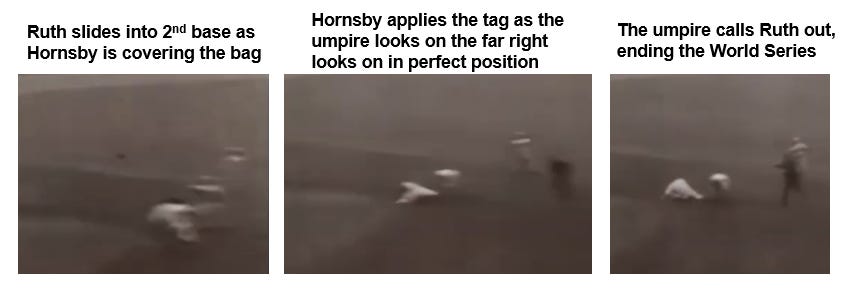
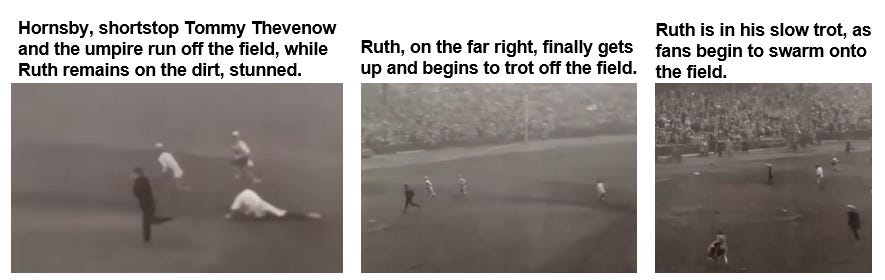
It was shocking. It happened so fast.
Babe Ruth tried to steal second base and was called out.
And the World Series was over with the St. Louis Cardinals as the victors.
Why did Babe Ruth Attempt a Steal With 2 Outs?
Brian Bell of the AP described the final daring play, “The Babe then made his last bid. He tried to place himself in a position to score on a hit by stealing second. He failed and St. Louis had come into its own after 40 years of weary waiting.”
Ben M. Hacock had this plausible explanation for why Ruth tried for the steal, “A last, mighty effort to win the battle by dint of legs when Alex refused his big bat a break!”
There was no consensus whether this was poor judgement by Ruth, in fact some applauded the ploy. One of the greatest sportswriters of the time, Damon Runyon, wrote this, “It ended with Mr. George Herman Babe Ruth being squashed on an attempt to steal second, a magnificent effort, at that.”
Thomas S. Rice in the Brooklyn Eagle staunchly defended Ruth’s decision to try for the steal “Babe Ruth’s attempt to steal second yesterday was logical in that he had a good gambling chance… He is still an excellent base-runner, despite his large size… He made a clean steal of second on Saturday last.”
That’s a reference to the fact that Babe Ruth had the only steal in the series for the Yankees, which he had achieved the previous day.
Rice continued, “The ball was heavy and more or less dead from the wet ground, making it difficult to throw. Ruth figured he had a gambling chance to steal second and score on a long single. John J. McGraw would almost certainly have figured the same…
That’s a reference to the Giants’ long time manager, who is considered to be the greatest manager in the game at this time.
Now back again to Rice, “as it was the play was close. Like Icarus, Ruth failed, but he failed in a great attempt.”
And it took a great throw to nail Ruth. Dick Williams of the INS wrote that “Bob O’Farrell’s peg was perfect.”
Westbrook Pegler of the Chicago Tribune concurred with Williams account of the throw, “O’Farrell shot the ball to Hornsby perfectly and he tagged the Babe on the toes as he slid into second.”
NOTE from The Sports Time Traveler
I interrupt the article yet again to inform you that in 100 years of debate and investigating, there has never been a definitive answer as to why Ruth tried to steal second.
Dick Williams of the INS, wrote, “Some say it was a hit and run play.”
Some say Ruth felt that as the team’s star player he had to take matters into his own hand (or legs actually).
All we know for certain is that it’s the only World Series to ever end on a runner being caught trying to steal a base.
Now back again to 1926.
The City of St. Louis Goes Wild!
While the players didn’t look excited in the few seconds we can see on the video, the city of St. Louis went wild with their 1st World Series Championship.
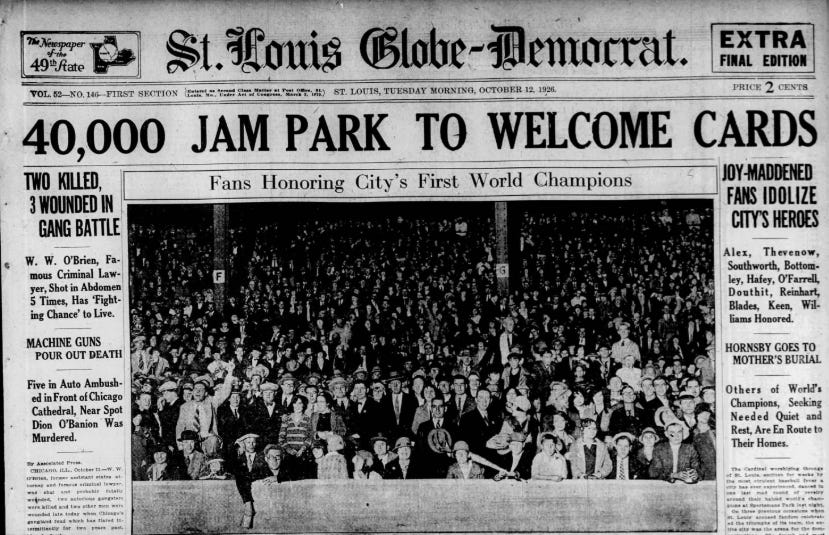
Page 1 of the St. Louis Globe-Democrat described the scene after the game 7 victory, “Celebration ran riot in St. Louis yesterday afternoon and last night in a wild orgy of jubilation and carnival over the sensational world championship victory… Scenes throughout… the city… took on aspect of some of the abandon that must have characterized the jubilations of ancient Rome.”
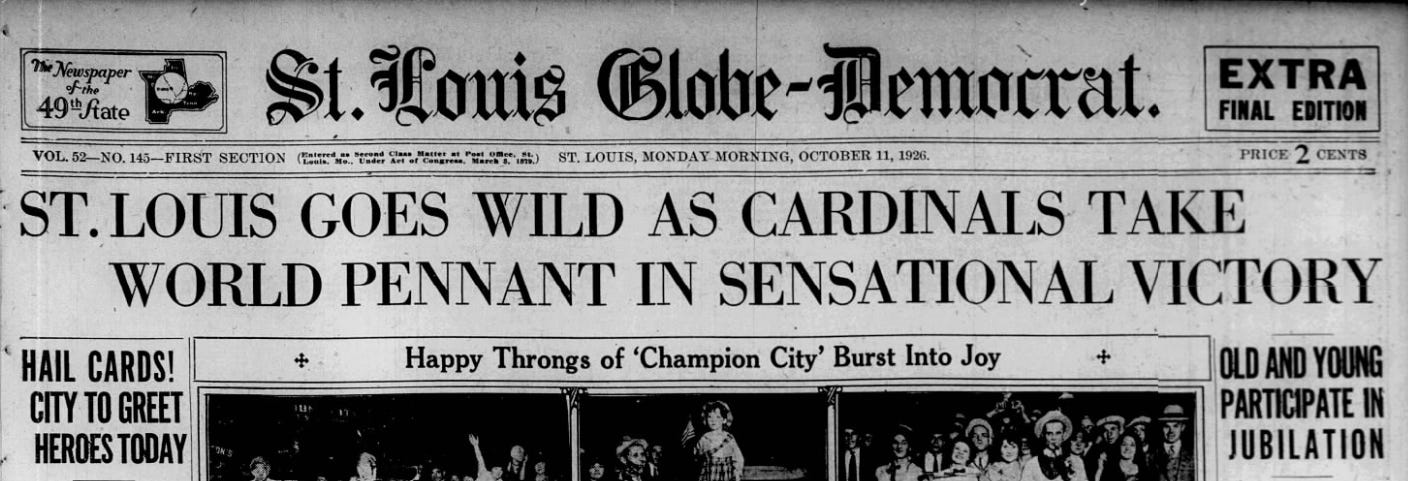
The next day the players arrived home after their long train journey. The plan was for the players to address the crowd in packed Sportsman’s Park, but it was an out of control mad house and the players, weary from having just gotten off an overnight train, had no opportunity to speak.
The headline of a story in the St. Louis Star and Times on October 12, 1926 read, “35,000 Over-Enthusiastic Fans Prevent Speeches of Cardinal Heroes in Welcoming Jubilee.”
The sub-heading read, “Throng Gets Beyond Control and Program Is Curtailed.”
And a picture of the packed ballpark appeared on the front page of the St. Louis Globe-Democrat the same day:
Hornsby Goes Home to Texas
There was no celebrating for Rogers Hornsby. The end of the World Series meant that Hornsby could finally go home to bury his mother who had died just before the beginning of the series. His mother had expressly made a dying wish that Rogers play and manage the Cardinals during the World Series and that they win.
Immediately after game 7, Hornsby left New York for Austin, TX.
A newspaper headlined declared, “Hornsby Off to Dead Mother in Texas After Leading Cards to World Title.”
Celebrating the Veteran Alexander
Newspapers around the country celebrated the ancient hurler and WWI veteran, Grover Cleveland Alexander. This was a real life fairy tale. The old man, discarded as done in June, was now the hero of the World Series in October.
Moreover, after 16 years in the major leagues, he was finally a World Series Champion, and more than anyone else on the Cardinals team, it was Alexander who had made the difference in defeating the Yankees.
He had won game 2 in spectacular fashion when the Cards were down a game and had to win.
He won game 6, again when the Cards were facing elimination.
And he shut down the Yankees in the final innings of game 7, not allowing a single hit or a ball to leave the infield.
And he did it on zero days of rest.
James R. Harrison wrote in the New York Times about Alexander, “He can look back to a series which saw him winning two masterful victories and helping to win a third. The man who was fired by Joe McCarthy, manager of the Cubs, in midsummer came back in October to turn out one of the greatest world’s series pitching achievements.”
It was a great story. It was the stuff of legends and myths. Four months shy of age 40, and given up as finished by the Cubs, he takes over the grand stage of the World Series and becomes the hero for the Cardinals.
Not only did Alexander win 2 games outright, yielding only 3 earned runs across those games, but he came back on no days of rest to pitch the most consequential innings of the series, the 7th to 9th innings in a one run game in game 7. Facing 8 batters he allowed no hits, no runs and only one walk to Babe Ruth.
Harrison in the New York Times wrote, “Though Jesse Haines received credit for pitching the deciding victory, it was Alexander’s aged arm that really stopped the Yankees… never was he more invincible than he was yesterday when he held them hitless over those last two and one-third innings. Not a ball was hit out of the infield.”
Days later the New York Times included this in their “This Week in Sports” column, “When the past season was half over Alexander was released by the Cubs unconditionally. Manager (Joe) McCarthy said he was through as a pitcher. When the world’s series started Alexander was generally thought of as a mere relief pitcher, able to las a few innings and get by through his cunning. But when the current world’s series ended yesterday Grover Cleveland Alexander, the old man unfit for service, once more was hailed as Alexander the Great.”
A Rampage of Records
The 1926 World Series set a wide array of records.
Babe Ruth set the record for most home runs in a World Series game with 3. That record has been tied by Reggie Jackson in 1977, but has never been broken.
By the way, The Sports Time Traveler was actually in Yankee Stadium for real in 1977 to see Jackson hit his 3 home runs in game 6. More on that to come when we reach the 50th anniversary of that game next year.
Babe Ruth also set the record for most home runs in a single World Series with 4. That record was broken by Reggie Jackson in 1977.
Babe Ruth also became the only player ever to homer or walk in every plate appearance in 2 games in a single World Series. He did it in both game 4 and game 7.
Grantland Rice presciently forecast this was a record that would stand the test of time, “ A double record that will last as long as Alexander’s arm defied the passing years.”
The Cardinals set a record in game 7 becoming the only team to ever win a game 7 without scoring a single earned run. The 3 unearned runs cost Babe Ruth from having the thrill of his 3rd inning homer being the winning run in the World Series.
There were also records for attendance and sales receipts for the games up to that time. Despite the low attendance in Yankee Stadium for game 7, the total attendance for the 7 games was 328,051, and ticket sales collected were $1,207,864.
And the record for a single World Series game attendance up to that time was set in game 2 at 63,600.
Of course there were also the records previously noted in part 1 for fastest train travel to and from New York to St. Louis, and most betting on a World Series, which I still find astonishing given that this was just 7 years after the “Black Sox” scandal.
Back to pure baseball records, in games 4 - 7, Ruth homered 4 times and walked 9 times in 20 plate appearances. He walked in 8 out of the next 15 plate appearances after hitting his 3rd HR in game 4. No one until Barry Bonds in the 2002 World Series ever had a stretch like that in World Series play.
Ruth also walked 11 times for a series record. That record was tied by Gene Tenace in 1973 and broken by Barry Bonds in 2002.
More Myth Making
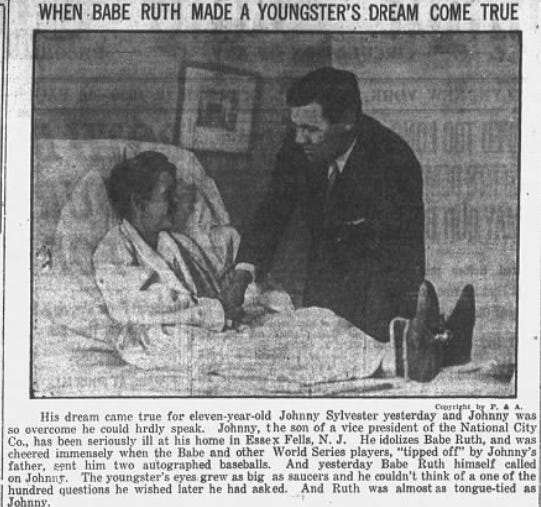
In part 1, I reported that Babe Ruth and Rogers Hornsby had sent autographed baseballs to a young boy who was deathly ill. Ruth has informed the boy he would hit a home run for him. Ruth exceeded his promise by hitting 3 in one game.
The day after the World Series ended, Ruth went to visit the boy, who was making a recovery.
Here is a picture of that visit that appeared in the October 12 Brooklyn Daily Times:
And so the real life legend of Ruth visiting sick and orphaned children was firmly established.
The 1927 Murder’s Row New York Yankees
I have become so enamored following the 1926 World Series that I have decided that next year in 2027, I will be following the 1927 Yankees day-by-day, 100 years in the past, during one of most iconic seasons in baseball history.
I will be posting stories when there is something so compelling that I just have to share it.
On other days, I will share updates via my Facebook page, “The Sports Time Traveler.”
I can’t wait!
BOOKS & XMAS GIFTS BY THE SPORTS TIME TRAVELER
If you enjoyed this article, explore my books on baseball.
The books make great Christmas or Channukah gifts for baseball fans.
Both of my baseball books have been accepted into the Baseball Hall of Fame Museum Library Collection in Cooperstown.
You can find them on Amazon:
Nice article Len. Lots of details and I like the story of Alexander the Great. I look forward to seeing the article about Murders Row. I recall my grandmother talking about them. Also, Not sure Ruth's stolen base effort would be so forgiven today, but given his greatness I guess critics might give him a pass.